The Reserve Bank began hiking rates last month, pivoting quickly from a rate cutting cycle that ended only in August of last year. Even so, housing prices have shown a notable degree of resilience. Cotality’s national dwelling values rose 0.8% in February, lifting annual growth to 9.9% and pushing the median dwelling value to around $923,000. Importantly, that resilience has been sufficient to push the national home value index back to a new peak, underscoring that higher rates have yet to derail price momentum at an aggregate level.
That headline strength continues to mask a widening divergence across the country. Regional markets again outperformed. Values in the regional areas were up 1.1% over the month compared with a 0.6% increase across the combined capitals.
In the capitals, the lift is being driven primarily by the mid-sized capitals with Perth leading the way, followed by Brisbane and Adelaide. The indexes for these three capital cities hit new record highs in February. Sydney and Melbourne, by contrast, were flat over the month and remain below their previous peaks, reflecting greater sensitivity to higher borrowing costs and weaker sentiment.
Differences are also evident across dwelling types and price points. House values rose 0.7% over the month and are up 10.7% over the year, while unit values increased 0.9% in February, lifting annual growth to 7.2%.
Taken together, the data point to a housing market that is still rising and, in many areas, making new highs, but increasingly segmented by geography, price point and exposure to interest rate risk.
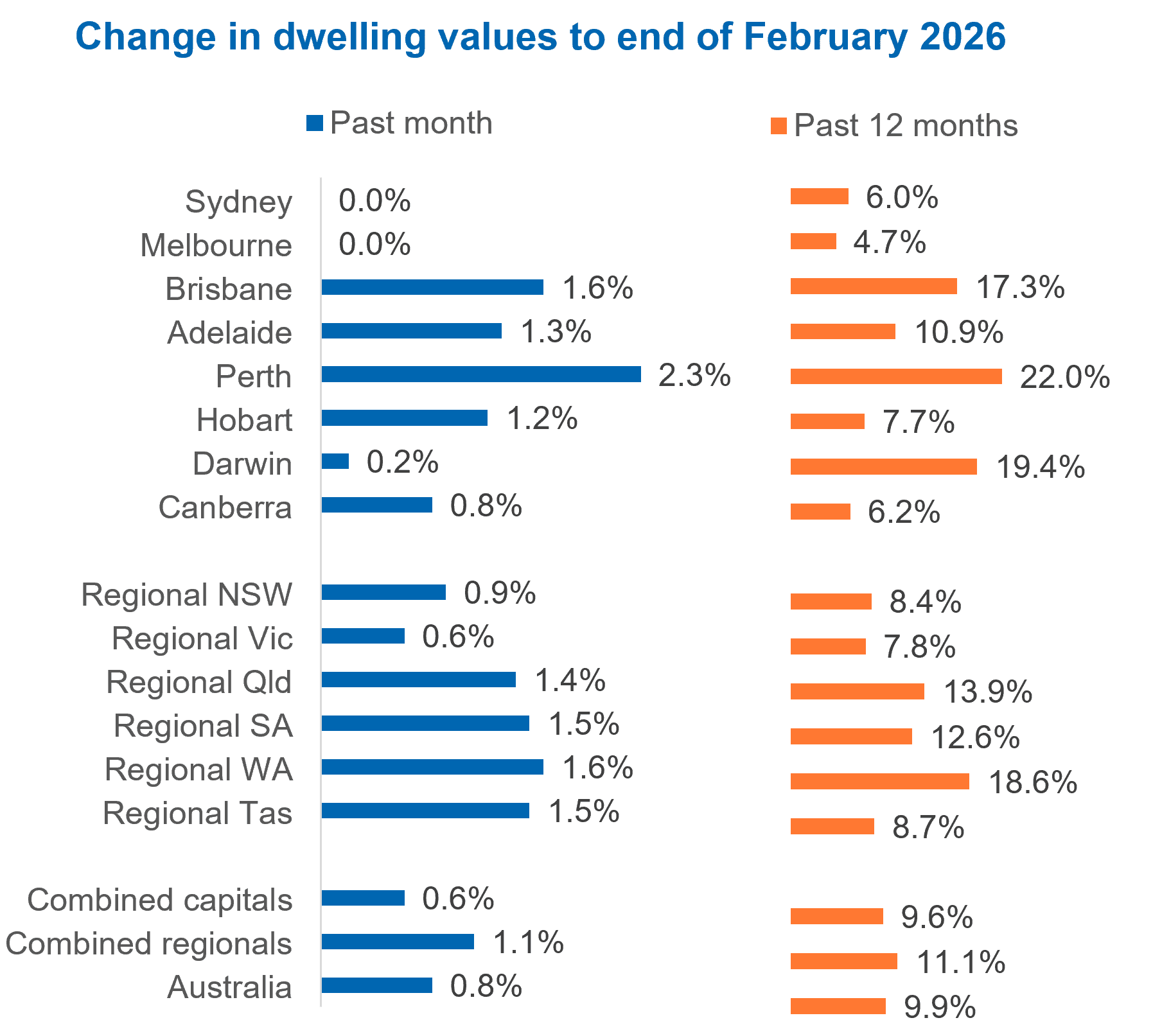
Source: Cotality, Macrobond
Disclaimer
This report has been prepared for general informational purposes only and does not constitute personal financial advice. It does not take into account your specific objectives, financial situation, or needs. Before acting on any information in this report, you should consider its appropriateness in light of your circumstances and seek independent financial advice. The author holds, or may hold, positions in some of the securities mentioned in this report. These holdings may represent a potential conflict of interest. No representation or warranty is made as to the accuracy, completeness, or reliability of the information contained herein. Past performance is not a reliable indicator of future performance.