The December quarter national accounts show the Australian economy ended 2025 with a firmer growth pulse. Momentum strengthened in the final quarter and historical revisions further lifted the recent growth profile, leaving the economy in a stronger position than the RBA had originally forecast.
Gross domestic product (GDP) grew by 0.8% in the December quarter and the previous quarter was revised a touch higher. On an annual basis, GDP growth lifted to 2.6%, from 2.1% in the September quarter. While the quarterly outcome was in line with both consensus and RBA expectations, the annual result exceeded forecasts (of 2.3%) due to data revisions. The outcome was also above the economy’s estimated potential growth rate of around 2.0%, suggesting activity was pushing beyond capacity, a scenario that creates inflationary pressures to build.
That stronger finish to 2025, however, comes with a more complicated composition of growth.
Household consumption, which accounts for the largest share of the economy, rose by 0.3% in the quarter and was up 2.4% over the year. The RBA is focused on the consumer and these outcomes are below the forecasts it published just last month. The strongest gains were concentrated in discretionary categories. These were spending on hotels, cafés and restaurants (+1.4% and the strongest quarterly outcome in 2½ years), clothing & footwear (+1.2% and the strongest result in a year) and furnishings & household equipment (+2.1% in the quarter).
However, some of our conversations with retail businesses suggest that 2026 has begun on a softer note, with consumer confidence more fragile following last month’s RBA rate hike. In recent days, there has also been growing nervousness about the impact of the Middle East conflict and what it could mean for Australia’s economy. The first‑round effects include higher energy prices, rising fertiliser costs and renewed supply‑chain disruptions
The household savings ratio rose from 6.1% to 6.9%, above its long‑run average. This suggests a degree of prudence has returned and it provides households with some buffer in the current backdrop.
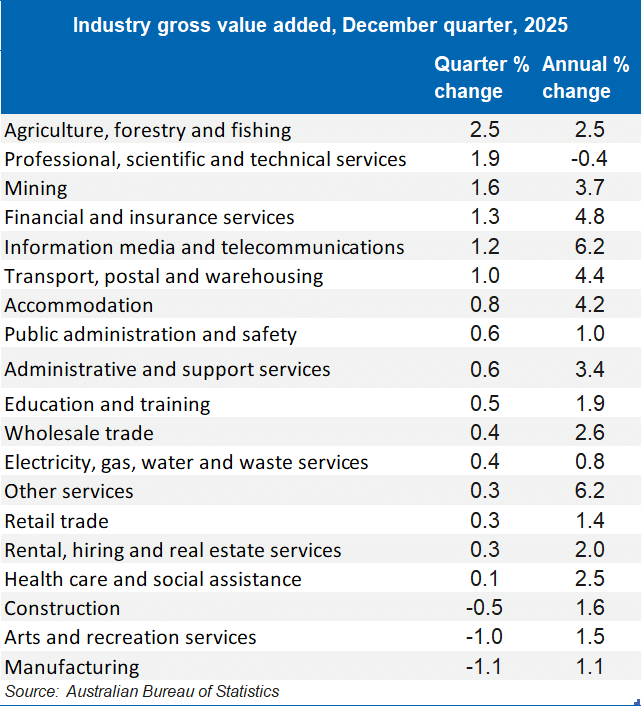
In contrast to the consumer, business investment continued to build momentum. Investment rose 0.7% in the quarter, marking a fifth consecutive quarterly increase. Annual growth lifted to 5.0%, the strongest pace in four years and around double the RBA’s forecast. This is a clear source of resilience in the economy and an important offset to softer household demand. That said, businesses are reporting elevated cost pressures, and for some this is resulting in margin pressure where higher costs cannot be fully passed through. The weakest production by industry occurred in manufacturing in the quarter.


Public spending has also been under significant scrutiny. Public demand rose 0.9% in the quarter and 2.4% over the year, making a sizeable contribution to growth in the December quarter, although as a share of the economy it is off a record high.
Today’s data comes in the wake of remarks from the RBA Governor Michele Bullock yesterday that sounded distinctly hawkish. She emphasised that every Board meeting is “live”, perhaps signalling that the Bank does not need to move on a strictly quarterly cycle.
Last year’s rate hikes occurred in February, May and August, each following the release of a quarterly inflation report. This year’s February hike again followed the quarterly inflation release. While a new monthly inflation indicator was introduced late last year, RBA officials have indicated that, for now, the quarterly series remains the primary focus as the Bank works through the properties and seasonal patterns of the monthly data.
If history is a guide and the RBA remains cautious, this points to May as the next most likely opportunity for a rate hike. Since the February meeting, both labour market data and January’s monthly inflation print have strengthened the case for further tightening. But there has not been a lot of data released and the Middle-East developments certainly add variability to the policy decision.
The impact of the conflict in the Middle East on the Australian economy, including inflation, will depend critically on the duration of the conflict and the extent to which it widens. At present, both remain highly uncertain. The conflict now directly involves Iran, Israel, Lebanon and the United States with several Gulf Cooperation Council (GCC) countries affected through retaliatory strikes and broader regional spillovers. This raises the potential risk that the conflict becomes more protracted, particularly given that the removal of a leader does not automatically translate into regime change in Iran.
The situation is deeply complex with significant geopolitical, economic and humanitarian dimensions.
Central banks typically look through temporary price shocks, but the duration and breadth of this conflict matter. The longer it persists and the wider it spreads, the greater the risk that inflation expectations become embedded and price pressures turn more persistent. At the same time, higher energy prices erode household disposable income, weighing on growth. This trade-off between inflation control and growth risks is the most challenging aspect of the outlook for central banks.
Our expectation is that the RBA remains biased towards higher rates in the near term, with a continued focus on inflation. Interest‑rate markets currently attach a probability of 20% to a rate hike at the 17 March meeting. We view this as too low and think it should be closer to double that. The March meeting is clearly live and while a back‑to‑back move would be unusual for the current Board, it would be consistent with a desire to not fall behind the curve given the risk of more persistent inflation shocks emanating from the Middle East. That said, the RBA’s traditional caution means we slightly favour May as the timing of the next rate hike.
Price measures within the national accounts are also worth considering. They showed a 1.4% rise in the GDP deflator in the December quarter. GDP per hour worked, a measure of productivity, was flat in the quarter and 1.0% higher over the year. Encouragingly, real unit labour costs, a metric closely watched by the RBA, moved in the right direction, falling by 0.6% in the December quarter and declining by 0.1% over 2025.