Australia

This half-year Dealmaking Insights update examines the emerging trends shaping Australia’s Mergers & Acquisitions (M&A), Initial Public Offerings (IPOs), Private Equity (PE) and Venture Capital (VC) markets, with a focus on what these trends mean for mid-market businesses.

While global uncertainty remains high, the Australian mid-market is still full of potential for business owners considering a sale or capital event.

Executive summary

Mid-market M&A activity in Australia has slowed to its lowest level in over a decade, with only 268 deals in the first half of 2025—down from an average of 500. Despite this, the middle market remains active and resilient, especially among businesses valued under $50 million.

Key drivers of activity include:

  • Private equity and large corporates pursuing smaller, bolt-on acquisitions.
  • Ageing business owners looking to exit after managing through the COVID pandemic.
  • Solid valuations and a focus on buyers looking to maintain growth especially with recurring revenue models.

However, challenges are growing:

  • Longer deal timelines due to economic uncertainty and tougher regulations.
  • More deals involving ‘earn-outs’ tied to future performance.
  • Geopolitical tensions and changing global trade rules are raising risks and slowing investor decisions.

What it means for mid-market business owners:

  • If you’re planning to sell or raise capital, start preparing early. Expect longer negotiations and more complex deal structures.
  • Businesses with strong recurring revenue, clear growth plans and a handle on AI-driven efficiencies will attract higher valuations.
  • Consider multiple exit options — trade sale or private equity, MBO, IPO, partial sale— and seek early advice to navigate regulatory complexity and maximise your value.

Looking ahead, deal activity is expected to pick up in the next 12 months, driven by interest rate cuts, ageing business owners preparing to retire and excess capital waiting to be deployed.

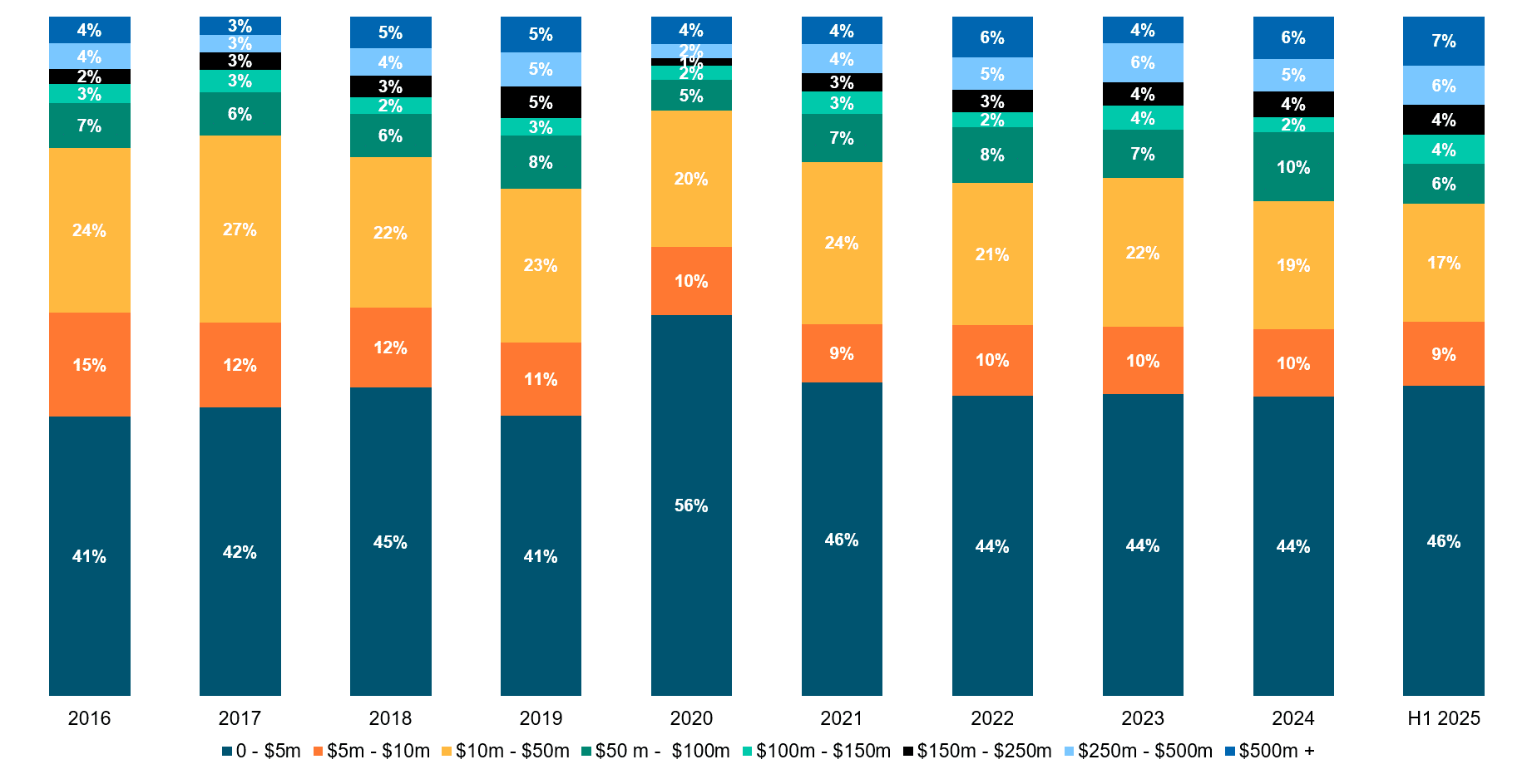
Breakdown of M&A Activity per transaction size category in Australia (2016-1H2025) (% of total # of transactions)

Market trends – first half of 2025

  • Smaller deals dominate, 72% of all M&A deals were valued under $50 million, highlighting the importance of smaller acquisitions to the Australian market.
  • Deal volume fell as uncertainty in the global economy continues to impact investor confidence and cause market volatility.

Why deals are still happening:

  • Large private, listed and PE/VC-backed companies are looking to expand through smaller, strategic, bolt-on acquisitions to increase revenue, profits or market share. This is preferred to organic growth, which tends to offer a slower expansion.
  • Elevated interest rates have increased the cost of capital and pushed buyers toward smaller, less risky acquisitions that can more easily integrate into existing businesses.
  • Ageing business owners (particularly those with businesses worth $10-50 million) are now seeking to exit after navigating through the COVID pandemic. Succession gaps and strong valuations are propelling exit decisions, as many business owners in the middle market see limited internal options and a favourable market window to cash out.

Challenges for mid-market businesses

  • Globally, escalating trade tariffs, geopolitical instability and the fragmentation of globalisation have increased risks for businesses.
  • Domestically, while inflation has moderated, consumer caution persists. Australia’s economic activity remains subdued, with a sustained recovery in household spending needed to strengthen the economic recovery.
  • The labour market remains tight, although there are soft signs of changes afoot and the unemployment rate has started to tick higher.
  • In this environment, mid-market businesses face heightened vulnerability, caught between the agility of smaller firms and the resilience of larger ones better equipped to absorb risks, including:

Key observations across all deals

  • Deals are taking longer stemming from global economic uncertainty and soft growth of consumer demand. The increased perceived risk is resulting in longer due diligence time for buyers who want more certainty on the performance of a target company.
  • More deals involve earn-outs to reflect the uncertain market conditions and higher cost of capital.
  • Focus on being sale ready while valuations are strong. Many businesses are focusing on understanding both the fair and strategic value of their business, ensuring they have a solid foundation of information available to support the due diligence process.
  • Companies with strong recurring revenue and profits attract high values, such as some healthcare companies.
  • AI is now a due diligence factor with buyers assessing how susceptible a target’s business is to technological threats. Businesses that have already made strong inroads in integrating AI in the past two years should be better placed, given the speed of change underway and the potential for a sharp improvement in productivity from AI.

Outlook for the mid-market

We expect an increase in M&A activity over the next 12 months due to:

  • Further rate cuts from the Reserve Bank with financial markets predicting three more rate cuts in August 2025, November 2025 and February 2026.
  • High levels of excess committed capital (estimated $30b in Australia) yet to be deployed by private equity and venture capital and accounts for approximately 10% of all M&A activity in Australia.
  • A generation of business owners looking to retire and exit, due to succession planning gaps and delayed retirement during the pandemic.

Global uncertainty slows deal activity

Australian M&A activity fell to a decade low in early 2025, with 268 deals and flat deal values around $22 billion. This slowdown reflects caution about shifting US tariffs and global trade rules, which indirectly affect Australia’s small, open economy. Added pressures include industry-specific tariffs, new ACCC and FIRB regulations and broader megatrends like AI and climate change — all contributing to longer deal timelines and more complex due diligence.

What this means for your business

Expect longer, more complex negotiations, with many deals structured with earn-outs to reflect the uncertain market conditions and elevated cost of capital. While some businesses have been able to navigate trade and tariff uncertainties by establishing new supply chains, others remain acutely exposed. All businesses are prone to further disruptions from ongoing and unpredictable tariff announcements. Early preparation and risk mitigation strategies will be crucial to progress deals efficiently and maintain investor confidence.

Innovation is redirecting capital

While traditional sectors like materials and industrials remain active domestically, global dealmaking is increasingly led by technology AI-driven innovation and data centres. This reflects the structural change or megatrend that is AI, which is set to accelerate and grow in importance as firms increasingly adopt and integrate AI to lift productivity.

What this means for your business

Unless your business is developing novel technology and AI solutions, investors are increasingly looking for profitable businesses or those that have a clear path to profitability. It is imperative for mid-market owners to consider and clearly articulate their business’ growth drivers to attract capital at sound valuations. Part of this process involves establishing a ‘baseline’ valuation and determining how these drivers are value-accretive over and above any initial capex and R&D outlays.

Evolving exit strategies in a complex market

The IPO market remains subdued, driven by heightened compliance costs, market volatility and geopolitical uncertainties impacting investor confidence. Private equity deals have rebounded, but challenges in achieving timely exits have led to investments being kept for longer and a greater reliance on continuation funds, which give investors the option to cash out or stay invested longer. It has also led to a greater dependence on other, alternative liquidity options. Concurrently, domestic regulatory changes, driven in part by geopolitical considerations around foreign investment, add layers of complexity to dealmaking and exits.

What this means for your business

Consider a variety of exit pathways (trade buyers, PE and/or IPO) and engage advisors early to navigate regulatory, structuring, succession planning and sale strategies to understand and control the sale process, increase optionality and maximise value at exit.

Looking ahead

Navigating economic uncertainty, industry sector changes and regulatory complexity requires strategic foresight and preparedness. Australian mid-market businesses that embrace these challenges while leveraging emerging opportunities will be best positioned to thrive in the years ahead.

Our half-year update is an extension of our annual Dealmaking Insights report for 2025, based on comprehensive research into Australia’s M&A, IPO, PE and VC markets, covering 2024 and examining trends over the past decade. 

Our data was sourced from S&P Capital IQ 2025, Pitchbook and Preqin

Do you have a question you'd like us to answer?

Send it through and we’ll get it to the right person.

Get in touch