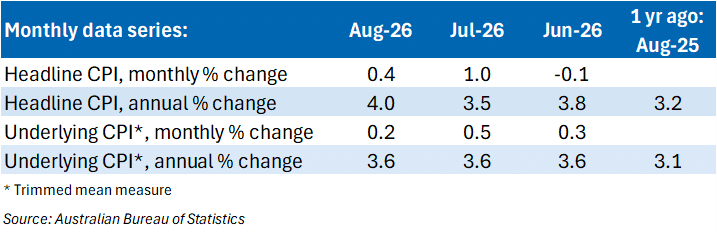
The August inflation data validated the Reserve Bank’s (RBA’s) decision to raise the cash rate yesterday to a 15-year high of 4.60%. Underlying inflation remained at 3.6% in annual terms, while services inflation was unchanged at 3.7%. The August result reflected a pick-up in goods and tradables inflation, driven largely by a sharp increase in automotive fuel prices. Fuel prices rose 14.8% in August, up from 7.5% in July, reflecting higher global oil prices as the conflict in the Middle East continues to disrupt energy markets.
In headline terms, inflation increased by 0.4% in August and lifted to 4.0% over the year. Headline inflation can be influenced by volatile items such as fuel, so the RBA places greater weight on underlying inflation when assessing medium-term inflation trends.


The $64 question is whether the RBA will move again in November. One of the key variables between now and then will be developments in the Middle East. The Governor noted yesterday that the conflict has broadened and deepened since it began, increasing uncertainty around the inflation outlook. Persistently elevated oil prices would keep upward pressure on automotive fuel costs and make it more difficult for inflation to return to target within the timeframe the RBA is seeking.
However, imported inflation is only part of the story. Home-grown inflation pressures remain evident with annual non-tradables inflation running at 4.5%, well above the 2.9% pace of tradables inflation. Non-tradables inflation captures goods and services that are less exposed to international competition and is, therefore, a useful gauge of domestic price pressures.
Transportation recorded the largest monthly increase in August, rising 4.2%, largely reflecting the surge in fuel prices. Offsetting this somewhat, food price growth was softer, particularly across meat & seafood and fruit & vegetables. Several discretionary categories, including clothing & footwear and recreation & culture, recorded price declines during the month. In annual terms, housing inflation remained the fastest-growing category, followed by transportation and education.
However, there were some perhaps encouraging signs beneath the surface. Underlying inflation rose by 0.2% in the month, below market expectations for a 0.3% increase. The three-month annualised rate of underlying inflation slowed from 4.7% to 4.1% and the six-month annualised pace didn’t accelerate, although it was elevated at 3.9%. In addition, one fewer inflation category was running above the RBA’s 2-3% target band compared with July.


Attention now turns to the September quarter inflation report, due for release in late October and the final major piece of the puzzle before the November Board meeting. We expect underlying inflation to rise by 0.9% in the quarter, taking the annual rate to 3.5%. That may be just enough to keep the RBA in wait-and-see mode, although the margin is slim and any upside surprise would strengthen the case for another rate increase. While financial markets have pared back expectations of a November move, they continue to price in a further rate increase in early 2027.
The RBA Governor acknowledged yesterday that monetary policy is already restrictive. The question now is whether it is restrictive enough to return inflation to target within a reasonable timeframe. The September quarter inflation report, together with developments in global energy markets, is likely to play a key role in answering that question.