Yesterday, Reserve Bank Governor (RBA) Michele Bullock spoke at an Australian Business Economists’ event supporting the ANIKA Foundation, which funds research into the prevention of youth suicide. I had the privilege of hosting the event.
During her remarks, Bullock noted that the labour market had been weaker than the RBA anticipated in recent months. The numbers support that assessment. In the June quarter, the unemployment rate averaged 4.4%, above the RBA’s forecast of 4.2%.
Bullock also indicated that housing market conditions had been softer than expected.
At the same time, Bullock reiterated the importance of ensuring inflation does not become embedded, noting that the further inflation moves from target, the harder it becomes to reverse. Against that backdrop, today’s inflation report had the potential to materially influence the outlook for interest rates.
And it did.
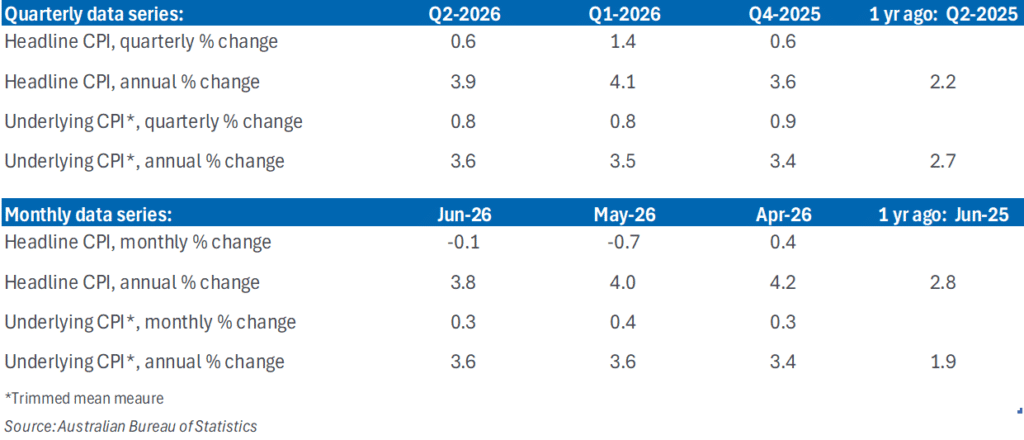
The data suggest inflation has likely peaked, while the pass-through from higher oil and material costs appears more limited than previously feared. More importantly, the quarterly inflation measures came in below the RBA’s forecasts (from their May statement on Monetary Policy).
Around a month ago, we considered removing our forecast for one additional rate hike in Q3 but ultimately retained it, given how finely balanced the decision appeared at the time. Today’s data have shifted that balance. While the rate outlook will no doubt be debated at the Board’s next meeting, we now expect rates to remain on hold and believe the hurdle for any further tightening has risen materially.
Financial markets have reached a similar conclusion. Shorter-dated swap yields have fallen significantly as investors have pared back expectations of another rate increase. Prior to Bullock’s speech, markets had effectively priced in one additional rate hike this year. That probability has now fallen to below 50% for this year and under 5% for the next Board meeting.
The RBA’s primary focus remains underlying inflation and today’s release provided the benefit of both the June quarter CPI and the monthly inflation indicator.
In the June quarter, underlying inflation rose by 0.8% with the annual rate easing to 3.9% from 4.0% in the March quarter. Both consensus forecasts and our own expectations had anticipated a 0.9% increase for the quarter.


In June, underlying inflation increased by 0.3% while the annual rate held steady at 3.6%. There was little evidence that higher oil and material costs were generating a broader lift in inflationary pressures. To date, second-round effects appear modest, supporting the case for the RBA to remain on hold.
The monthly data do, however, point to some ongoing stickiness in services inflation. Services inflation accelerated from 3.7% year-on-year in May to 4.0% in June, the highest reading since December last year. Offsetting this was a 0.3% decline in goods inflation, which helped keep annual underlying inflation steady at 3.6%.
Tradables inflation also recorded another sizeable decline with the stronger Australian dollar helping to lower the cost of imported goods and services.
More broadly, as economic activity slows, businesses appear to be facing greater resistance in passing higher costs on to consumers, reducing the risk that inflation pressures become embedded. However, geopolitical tensions in the Middle East continue to create uncertainty around oil prices, meaning the risk of further tightening cannot be completely ruled out.