

The shoulders of Australia’s jobs market are starting to slump. The labour market held up for some time, but as higher interest rates, elevated fuel prices and rising uncertainty have filtered through the economy, the rise in unemployment we had been foreshadowing has now arrived.
The unemployment rate lifted 0.2 percentage points to 4.5% in April. That is the highest rate since November 2021. The survey was in the field from 29 March to 11 April, so it predates the May rate hike and recent tax changes announced as part of the Federal Budget. This month’s rate hike is likely to reinforce caution among businesses, and early signs suggest the tax package may amplify that. Businesses gripped by caution are less likely to be actively hiring.
Jobs fell by 18,600 in April, the biggest drop in five months. That caught markets off guard. Consensus had expected a gain of 15,000 in the month. Both full-time and part-time jobs fell, by 10.7k and 7.9k, respectively. At the same time, March employment was revised up by 3,400, but the April result still points to a clear loss of momentum. It raises questions about the speed of the slowdown and suggests the economy may be cooling faster than anticipated.
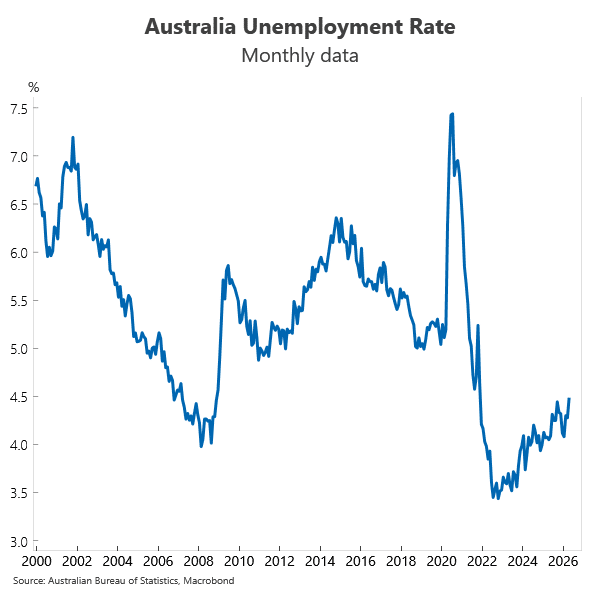
Indeed, the RBA’s forecasts published only last month point to an unemployment rate of 4.4% for the June quarter. April’s result, the start of the quarter, has already exceeded that.
The challenge for the RBA is that employment is a lagging indicator, yet its forecasts already look too optimistic. Officials have continued to describe the labour market as “still a little tight”, but today’s data may mark a turning point that forces a shift in tone.
The jobs market is still in good shape, but a softening is underway. It is increasingly difficult to reconcile the current mix of indicators with the idea of a tight labour market.
For monetary policy, this lowers the bar for another rate hike. The RBA targets low and stable inflation and full employment. Inflation would be prioritised if push came to shove. The ongoing closure of the Strait of Hormuz and growing flow on effect of higher fuel prices may keep another hike in play. It has been our view for some time that the RBA would deliver four hikes with a pause in June, taking the cash rate to a peak of 4.60%. Three have been delivered, and one more remains in play. Swap markets continue to be priced for one more hike, although that timing has now pushed out to late 2026.
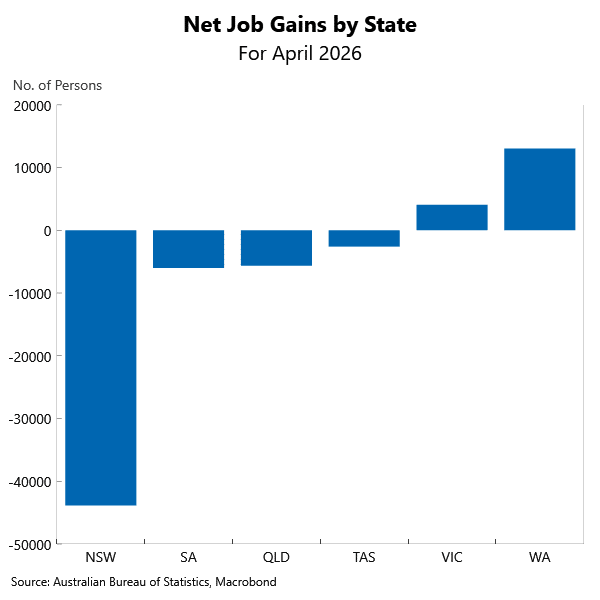
Four of the six States recorded declines in employment in April. NSW led the declines with a fall of 43,900 – the largest since August 2021 when Australia was still in the grips of COVID. NSW holds the title for the largest mortgages, so rate rises hit harder. Western Australia and Victoria were the only two states to record gains, of 13,000 and 6,000, respectively. But Victoria’s unemployment rate stood at 4.8% in April – the highest since late 2021 and the highest of any State. In contrast, Western Australia’s dropped to 4.1% and is the lowest of the States.
Job advertisements and business surveys point to slower employment growth ahead. The NAB business survey showed a very weak reading in March and April and the employment sub-index fell to its softest since June 2024. Job advertisements are easing, falling for three consecutive months, but not yet signalling a sharp slowdown in jobs growth. Excluding the covid period and relative to history, job ads remain relatively elevated.
Unusually, hours worked rose a strong 0.8% in April, after a 0.5% gain in March. As the economy weakens, we would typically expect hours to ease, alongside slower hiring and ahead of rising layoffs. This may suggest we need more data to judge the pace of cooling or it may reflect firms holding back on hiring as uncertainty around the outlook remains high. Either way, it does not change the broader message. The labour market is easing.