As I was writing this note, I received yet another unsolicited call from a real estate agent pitching their services. It was one of several this week. The increase in calls reflects a housing market that is losing momentum. Dwelling prices are softening, turnover is slowing and listings are accumulating as homes spend longer on the market.
Fresh data from Cotality released today shows the national home value index fell 0.4% in June, the largest monthly decline since late 2022 and the third straight monthly fall. Not since late 2022 has the market experienced such a sustained period of weakness. Annual dwelling price growth has eased to an eight-month low of 7.3%, highlighting the continued softening in housing conditions.

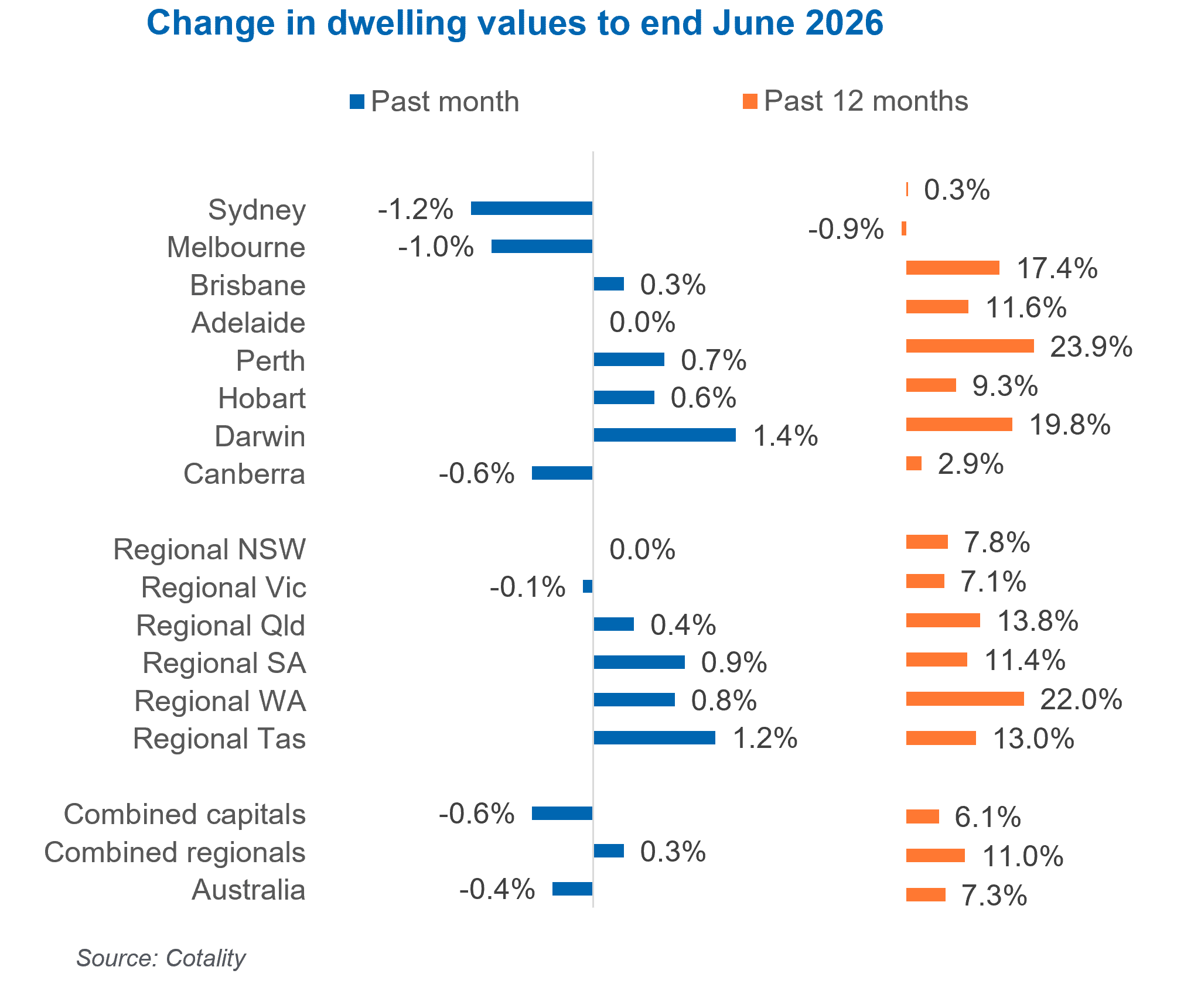
In June, a 1.2% drop in Sydney prices delivered the most significant drag on the headline result, followed closely by Melbourne with a 1.0% drop and the ACT with a 0.6% fall.
While the pace of monthly growth slowed across almost every state and capital city in June, most mid-tier capital cities remained an exception. Brisbane maintained its monthly rate of growth (of 0.3%) and Perth picked up pace (from 0.6% in May to 0.7% in June), contrasting with the moderation evident elsewhere. Outside the capitals, Western Australia recorded no slowdown in growth, while Tasmania saw monthly momentum strengthen further.
In fact, Queensland, Western Australia, South Australia, Tasmania and the Northern Territory all reached new peaks in the home value index in June. The same was true for Brisbane, Perth, Adelaide and Darwin. Meanwhile, nationally, dwelling values are 0.7% below the peak reached in March 2026. The sharpest declines from peak levels have occurred in Victoria, where values are down 3.0%, followed by New South Wales, down 2.7%. The ACT is also down from its peaks.


Houses vs units
Affordability pressures are weighing more heavily on detached housing than units. House values fell 0.4% in June, compared with a 0.2% decline in unit values. That disparity is unsurprising given units remain a more affordable option for buyers navigating higher borrowing costs following three cash rate increases by the Reserve Bank this year.
Median values
The shifting fortunes of Australia’s housing markets are also evident in the rankings of the nation’s most expensive cities. Sydney remains the most expensive market by median value. Brisbane and Perth are in second and third place, respectively. Melbourne sits behind both Hobart and Darwin. This marks a dramatic shift from just a few years ago, when Melbourne was Australia’s second most expensive housing market. Brisbane overtook Melbourne in December 2023, while Adelaide and Perth moved ahead in August 2024. Victoria’s investor-focused land tax changes, announced in May 2023 and taking effect from January 2024, have likely contributed to this relative underperformance and provide a useful case study of how taxation settings can shape housing market outcomes.
Even before the proposed Federal Budget tax changes, housing demand was under pressure from affordability constraints, rising living costs and weak consumer confidence. The planned changes to negative gearing and capital gains tax have introduced a further source of uncertainty, leading some investors to reassess their appetite for residential property. Given investors have been an important source of demand across many housing markets, a pullback in investor activity is likely to place additional downward pressure on demand for established dwellings.
Forecasts
We have revised our dwelling price forecasts and now expect national dwelling values to decline by around 1% in 2026, with Sydney and Melbourne likely to experience larger falls. Auction clearance rates have been trending lower and have remained below 50% since late May, signalling further weakness in housing demand and pointing to additional softening in dwelling prices.
We also continue to see the risk of one further interest rate increase in the September quarter. Should that occur, higher borrowing costs would place additional pressure on housing demand and add to the downward momentum already evident in parts of the market.
Rents
We see a risk that some pressure may shift from dwelling prices to the rental market. National rents rose 0.4% in June following a 0.5% increase in May, taking annual rental growth to 5.9%.
Rental conditions remain extremely tight with the national vacancy rate sitting at just 1.6% in June. Although slightly higher than the 1.5% recorded in May, it remains well below the long-run average of 2.5% and comfortably below the 3% threshold associated with a balanced rental market.
Housing supply
On the supply side, building approvals have improved, but development feasibility remains constrained by higher financing, fuel and material costs, together with ongoing skilled labour shortages, limiting the pace at which new housing supply can come online. As a result, new supply is unlikely to come online quickly enough to eliminate Australia’s housing shortfall. Combined with strong population growth, these constraints should continue to provide a floor under housing prices, even as broader market conditions soften. However, it’s clear that buyers are starting to slowly gain some leverage, underpinned by higher levels of advertised sticks, longer selling times and softer auction rates.


Disclaimer
This report has been prepared for general informational purposes only and does not constitute personal financial advice. It does not take into account your specific objectives, financial situation, or needs. Before acting on any information in this report, you should consider its appropriateness in light of your circumstances and seek independent financial advice. The author holds, or may hold, positions in some of the securities mentioned in this report. These holdings may represent a potential conflict of interest. No representation or warranty is made as to the accuracy, completeness, or reliability of the information contained herein. Past performance is not a reliable indicator of future performance.