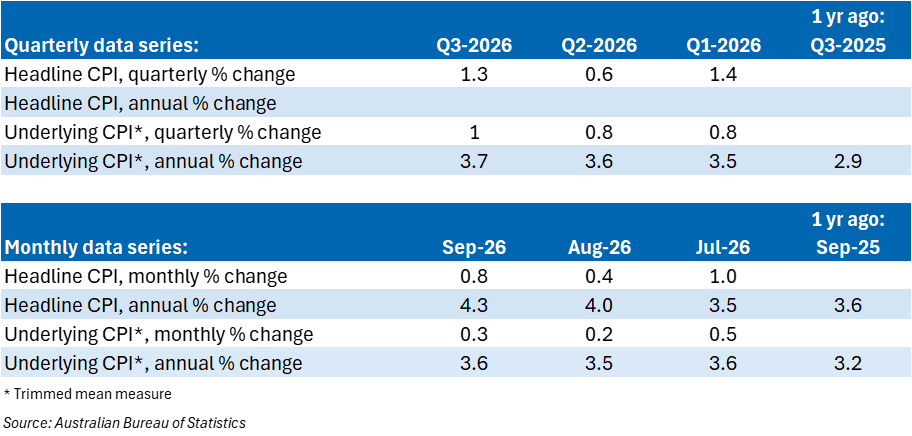
The market was divided ahead of today’s inflation data over whether another rate hike would materialise as soon as November. So too were economists. An underlying inflation outcome above 3.6% in the year to September in the quarterly series was largely seen as sealing the deal. And that’s what was delivered.
Underlying inflation rose by 1.0% over the quarter, with the annual rate lifting from 3.6% to 3.7%. In the monthly series, underlying inflation rose by 0.3% with the annual rate increasing from a revised 3.5% in August to 3.6% in September. Headline inflation also accelerated, rising from 4.0% to 4.3% over the year. The concern for the RBA is that underlying inflation is moving further away from the 2–3% target band, rather than simply taking longer to return to it.


Market services inflation, a measure the RBA also watches closely, rose from 4.1% in August to 4.3% in September in year-on-year terms, although the monthly growth rate showed some moderation. The quarterly series also recorded an annual rate of 4.3%. Both measures show domestic inflation pressures remain stubborn and sticky. Higher oil and other input costs from the escalation in the Middle East conflict are causing upside risks to inflation to build. But the market services measure reveals it’s not just an oil story.
Swap markets were quick to shorten the odds of a rate hike on Melbourne Cup day. Market pricing moved to an 85% chance of a 25-basis-point increase following the inflation release. The repricing also follows a noticeable shift in the tone of RBA communications over the past week. Deputy Governor Andrew Hauser warned that the inflation outlook looked “materially worse” than the RBA had projected in August, highlighting the risk that persistently high inflation could become embedded in expectations. He noted signs that some businesses were beginning to regard inflation of 3–3.5% as the “new normal”, describing a drift in inflation expectations away from target as a central banker’s “nightmare”.
Those concerns were reinforced when Governor Michele Bullock and Hauser appeared before a Senate economics committee following the inflation release. Bullock acknowledged that some of the upside risks identified in the RBA’s August forecasts had since materialised, meaning inflation was now likely to be higher than the Bank’s earlier base case.
Assistant Governor (Economic) Sarah Hunter’s appearance on 60 Minutes over the weekend was also unusual for the RBA and came amid this broader intensification of public communication. While it would be difficult to know the Bank’s motivation, the timing adds to the sense that policymakers are increasingly focused on communicating the persistence of the inflation challenge and the possibility that interest rates may need to rise further to bring inflation back under control
The wildcard remains developments in the Middle East and the associated surge in energy prices. Brent crude has remained above US$100 a barrel through much of October and recently traded above US$117 as geopolitical tensions intensified. The longer oil prices remain elevated, the greater the risk that higher fuel and transport costs feed more broadly through supply chains and ultimately into consumer prices.
There is also some uncertainty around the inflation impact of the removal of card payment surcharges. Businesses can no longer separately surcharge customers paying by major card networks, but they can adjust their underlying prices to recover the cost of accepting card payments. It is too early for the full effect of this change to be evident in today’s inflation data, although some businesses may have adjusted their pricing ahead of its formal introduction.
We remain particularly concerned about the stickiness of services inflation, where disinflation has been limited. At the same time, goods inflation has moved higher, partly reflecting the renewed surge in fuel prices. The uncomfortable combination for the RBA is therefore persistent domestically generated inflation alongside a renewed external price shock.
That does not make a November rate hike a certainty. The Reserve Bank of New Zealand (RBNZ) provided a timely reminder of that this week, surprising markets by leaving its official cash rate unchanged at 2.75% despite widespread expectations of a 25-basis-point increase. The decision was finely balanced with the Monetary Policy Committee voting 4–3 to hold. However, we do not think this scenario will play out in Australia and expect the RBA will need to raise rates again. The persistence of domestic-capacity pressures, compounded by the renewed external price shock, gives the RBA a stronger case to tighten further.