Australia

Australia’s sustainability reporting framework requires certain entities reporting under Chapter 2M of the Corporations Act 2001 to prepare an audited sustainability report, which includes climate-related financial disclosures in accordance with Australian Sustainability Reporting Standards (ASRS) made by the Australian Accounting Standards Board (AASB). This report needs to be issued at the same time as the audited financial report.

There are effectively three key components to the new sustainability reporting framework:

  • Legislative requirements per the Corporations Act 2001
  • Australian Sustainability Reporting Standards (ASRS) issued by the AASB
  • Australian Standards on Sustainability Assurance (ASSA) issued by the Auditing and Assurance Standards Board (AUASB)

How we support your Sustainability Assurance

We provide assurance services that go beyond compliance, helping organisations build trust with the market and demonstrate the integrity of their reporting.

Our services include:

  • Gap and readiness assessments
    Helping entities identify areas that need to be addressed to enable them to prepare and issue audited sustainability reports.
  • Independent assurance engagements
    Conducting limited and reasonable assurance engagements in line with ASSA 5000, covering governance, strategy, risk management and emissions disclosures.
  • Phased assurance readiness
    Supporting entities to meet the phased assurance requirements under ASSA 5010 — from limited assurance in the first year through to full reasonable assurance.
  • Controls and process evaluation
    Reviewing and strengthening internal controls, data collection and reporting processes to prepare for external assurance.
  • Stakeholder confidence uplift
    Helping boards, investors and regulators gain confidence that reported information is robust, consistent and help them make informed decisions.
  • Board briefings and training workshops
    Helping directors understand sustainability reporting requirements to help them manage their obligations under the Corporations Act 2001 and to be able to respond to shareholder and stakeholder queries.

Why Assurance matters

Assurance gives you confidence that your sustainability reporting meets regulatory requirements and stands up to stakeholder scrutiny. From 2025, it’s mandatory under the Corporations Act 2001 for entities in scope, but the benefits go far beyond compliance. Independent assurance builds trust with investors, regulators, and the market by demonstrating transparency and credibility. It also helps protect your organisation from reputational and regulatory risks through strong, reliable processes. Most importantly, assurance creates opportunities for improvement, strengthening governance, refining controls and enhancing the quality of your reporting year after year.

Our teams are leaders in assurance and sustainability reporting, combining technical expertise with a pragmatic approach. We provide confidence that your disclosures meet not only regulatory requirements, but also stakeholder expectations for high-quality, reliable reporting.

FAQs

What is the purpose and structure of a sustainability report?

A sustainability report is not limited to reporting on carbon emissions. The report aims to provide users with information about climate-related risks and opportunities that could reasonably be expected to affect an entity’s cash flows and access to funding over the short, medium or long term. The report comprises the following key disclosures:

  1. Governance processes, controls and procedures to monitor, manager and oversee climate-related risks and opportunities
  2. Strategy, including an assessment of climate-related risks, opportunities, resilience and current and anticipated financial effects
  3. Risk management processes to identify, assess, prioritise and monitor climate-related risks and opportunities.
  4. Metrics and targets including reporting on Scope 1, 2 and 3 greenhouse gas emissions

Which entities are required to prepare mandatory sustainability reports?

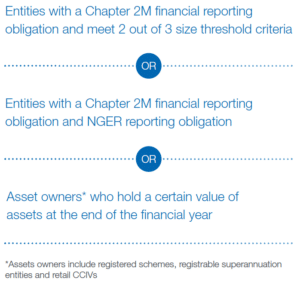
Australian entities required to prepare and lodge a financial report with the Australian Securities and Investments Commission (ASIC) under Chapter 2M of the Corporations Act 2001 must prepare a sustainability report if they meet certain criteria.

Entities in scope per the Corporations Act 2001 who are required to prepare sustainability reports:

Our guide to Australia’s new sustainability reporting framework can assist you further in determining whether your entity is subject to mandatory sustainability reporting, as well as when your entity will be required to report for the first time.

When are entities in scope required to report?

A phased approach to the first year of reporting will apply to entities in scope. It is important to first assess whether the entity is required to lodge a financial report under Chapter 2M of the Corporations Act 2001 before assessing what category they might fall under for the first year of reporting.

Mandatory reporting of climate-related disclosures for certain entities submitting financial reports to ASIC under Chapter 2M of the Corporations Act 2001 will commence for financial years beginning on or after 1 January 2025 for Group 1 entities, 1 July 2026 for Group 2 entities and 1 July 2027 for Group 3 entities. It is important to note that the sustainability report forms part of the annual report and therefore has to be issued at the same time as the financial report.

What are the sustainability reporting standards?

The AASB issued the first sustainability reporting standards in September 2024, which are:

  • AASB S1 General Requirements for Disclosure of Sustainability-related Financial Information – a voluntary Standard
  • AASB S2 Climate-related Disclosures – a mandatory Standard.

What are the assurance requirements for your sustainability report?

The sustainability report will be subject to assurance requirements similar to those currently prescribed in the Corporations Act 2001 for financial reports. The AUASB has released ASSA 5000 General Requirements for Sustainability Assurance Engagements, which will apply to sustainability assurance engagements for reporting periods beginning on or after 1 January 2025.

For mandatory climate reporting required under the Corporations Act 2001, the AUASB also approved ASSA 5010 Timeline for Audits and Reviews of Information in Sustainability Reports under the Corporations Act 2001, which outlines the phasing in of limited and reasonable assurance over the relevant information required by AASB S2 Climate-related Disclosures for each of the three groups of entities.

The assurance phasing model adopted by the AUASB requires limited assurance over disclosure requirements relating to governance, strategy (risks and opportunities) and Scope 1 and 2 emissions in an entity’s first reporting year, moving to reasonable assurance for all mandatory disclosure requirements from the fourth year of reporting.

This means investors, regulators and stakeholders will expect credible, reliable and assured information – on the same level of confidence as financial statements.

Key contacts

GrantMartinella58201493223

Grant Martinella
Partner, Audit & Assurance

Adelaide

Ross Burt
Partner, Audit & Assurance

Melbourne

Amar Nathwani
Partner, Audit & Assurance

Perth

RAhrens21472016124118

Rainer Ahrens
Partner, Audit & Assurance

Sydney

Matthew Monaghan
Partner, Audit & Assurance

Brisbane

Mark Smit
Head of Sustainability Reporting

Melbourne

Resources

Focus on sustainability: A guide to Australia’s new reporting framework 

Focus on sustainability: An overview of ASRS

Focus on sustainability: The role of governance in climate-related financial disclosures

Focus on sustainability: Identifying material climate-related risks and opportunities

Video resources

Webinar: Sustainability & mandatory climate reporting requirements

Webinar: An Overview of the Australian Sustainability Reporting Standards (ASRS)

Webinar: Focus on Sustainability | AASB S2 | Pillar 2: Strategy – Climate resilience and scenario analysis

Webinar: Focus on Sustainability | AASB S2 | Pillar 3: Risk Management

Webinar: Focus on Sustainability | AASB S2 | Pillar 1: Governance

Webinar: Focus on Sustainability | AASB S2 | Pillar 2: Strategy

Webinar: Focus on Sustainability | AASB S2 | Pillar 4: Metrics & Targets – Measurement of carbon footprint

Webinar: Navigating mandatory climate reporting and your first sustainability report

Related insights

28 November 2025 |Minutes to read: 3

Are you burning through cash too quickly?

“It’s not pretty. The way things are going we’re not going to finish for five months and...
23 October 2025 |Minutes to read: 3

Unlocking hidden value: Understanding and capitalising intangible assets

For many business owners, the true value of your business extends far beyond the physical assets. Brand...


26 September 2025 |Minutes to read: 3

ZEPOS vs Performance rights: what’s the smarter choice for your equity plan?

For founders and CFOs scaling businesses in Australia, navigating the complexities of equity incentives is a critical...
22 September 2025 |Minutes to read: 3

Mandatory climate reporting one year on: top challenges for CFOs

It has been just over a year since Australia legislated mandatory climate reporting for certain entities and...
29 August 2025 |Minutes to read: 3

What are ‘exploration and evaluation assets’ and how are they measured?

If you’re asking, ‘what are exploration and evaluation assets?’, the answer lies in their accounting treatment and...
12 August 2025 |Minutes to read: 3

How governance has become a strategic edge for manufacturing businesses

In manufacturing today, strong governance is the foundation of resilience, competitiveness and growth. Businesses that treat governance...

Do you have a question you'd like us to answer?

Send it through and we’ll get it to the right person.

Get in touch