For Australian manufacturers, AI presents a compelling opportunity to produce smarter, faster and more efficiently. But adopting AI is only part of the equation. The manufacturers that gain the greatest competitive advantage will be those that can use their data and AI safely, consistently and at scale.
Automation, advanced analytics, artificial intelligence (AI), digital twins and connected production systems are creating opportunities to improve productivity, quality, safety and responsiveness in manufacturing. However, these technologies are only as valuable as the data and governance frameworks that sit behind them.
AI adoption is accelerating across the Australian economy. The Australian Bureau of Statistics reported that 12% of Australian businesses were using AI in 2024-25, with adoption rising to 35% among large businesses.
For manufacturers, the challenge is no longer whether AI can improve manufacturing; it is how can we use it safely and turn it into a sustainable competitive advantage?
In this third article in a series exploring good governance in manufacturing businesses, we look at why high-quality data and AI governance is critical to bridging the gap between AI ambitions and commercially viable execution.
Data – a strategic intangible asset
In manufacturing, data is often inseparable from intellectual property (IP). Production recipes, engineering drawings, machine parameters, quality records, supplier information, maintenance histories and customer specifications can represent decades of accumulated knowledge and competitive advantage.
Introducing AI without appropriate data governance can unintentionally expose this advantage and put it at risk. Employees may upload confidential information into external AI services, suppliers may gain access to proprietary datasets, or poorly controlled models may incorporate sensitive information into processes that are difficult to audit.
Effective governance starts with knowing what data exists, who owns it, where it is stored, who can access it and how it can legally be used.
Australia’s Voluntary AI Safety Standard highlights the importance of data quality, provenance, cybersecurity, privacy and documenting data usage rights, including intellectual property and contractual rights.
For manufacturers, this means treating data as a valuable industrial asset which requires governance frameworks comparable to those used for financial assets, patents and critical infrastructure.
Compliance must be built into the production system
As AI becomes embedded in operational decision-making, governance can no longer be viewed solely as a technology issue.
Australia’s Voluntary AI Safety Standard identifies accountability, risk management, data governance, testing, monitoring and meaningful human oversight as foundational requirements for responsible AI adoption.
These expectations increasingly align with broader board responsibilities for risk management, cybersecurity, safety and compliance.
Boards do not need to understand every technical aspect of AI. However, they should understand where AI is being used, what risks it introduces, how intellectual property is protected and who is accountable for outcomes.
Management, in turn, should establish clear governance processes around data ownership and stewardship, AI risk assessments and human oversight.
Done well, governance should not become a barrier to innovation. It should give businesses the confidence and control they need to innovate faster, safely and scale successful AI applications.
Closing the gap between AI ambition and safe execution
Many organisations have no shortage of AI ideas. The difficulty is turning those ideas into production outcomes.
Recent Australian AI adoption research identified trust as one of the most significant barriers to broader implementation, with many businesses expressing concerns around transparency, control and decision-making accountability.
Successful organisations address these concerns by implementing structured process flows to AI deployment:
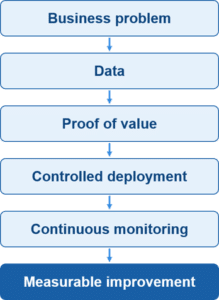
Governance does not slow innovation. It enables organisations to move from experimentation to repeatable commercial outcomes.
Making Australian manufacturing more competitive
Australian manufacturers face structural challenges including higher labour, energy, freight and compliance costs than many international competitors.
Competing solely on cost is increasingly difficult. Competing through intelligence, innovation, quality and operational excellence is far more achievable.
Data and AI governance provide the foundation: protecting intellectual property, maintaining compliance, controlling operational risk and creating confidence in automated decision-making. Continuous improvement provides the operating philosophy. Advanced analytics and AI provide new capabilities for seeing, predicting and optimising the production system.
Together, these capabilities create a pathway from digital ambition to industrial performance.
For Australian manufacturers, the strategic question is therefore not simply, “Where can we use AI?” It is, “How can we govern our data and AI so that every improvement makes the business more resilient, efficient and competitive?”
That is the foundation for ensuring that locally made products are not only innovative, but viable, scalable and globally competitive.
Where should your business start?
Effective AI governance needs to balance innovation with the protection of your data, IP and broader business interests. The right approach will depend on where your organisation is today, how you are using AI and where you want to take it next.
If you’re considering how data and AI can improve your manufacturing business, speak with a William Buck advisor about building the governance, risk and strategic foundations needed to turn AI investment into sustainable commercial outcomes.
Read the other two articles in our series about exploring good governance in manufacturing businesses: