For many business owners, finance and administration functions are the silent engine room, vital to smooth operations, but often resource-hungry and time-consuming. Artificial intelligence is no longer an emerging concept. It is now embedded in many of the systems SMEs already use, from accounting platforms to payroll software and document management tools. The opportunity is not simply automation, it is improving visibility, accuracy and decision-making without increasing headcount.
The challenge is knowing where to start. Below are five practical steps you can take to identify and implement AI and automation opportunities in your business.
Map out your repetitive tasks
The best place to start is by examining the activities your team performs daily or weekly. Accounts payable, payroll processing, expense approvals and reconciliations are common culprits. Other time sinks we regularly see in SMEs include manually entering supplier invoices into accounting systems, chasing overdue debtors and re-keying employee expense claims from spreadsheets into payroll.
Some examples of where we are seeing AI used in SME’s include:
- AI-assisted month-end close checklists
- Automated variance commentary in management reports
- AI-generated board pack summaries
- Predictive cashflow alerts based on debtor behaviour
Today’s platforms can automatically extract and code invoices, generate intelligent payment reminders, flag unusual transactions and even produce draft commentary for management reports. Some tools can also predict cashflow pressure before it becomes visible in traditional reports.
Simply asking staff what tasks they find most repetitive or least valuable will quickly highlight where AI and automation can create an immediate impact.
Ensure your data foundations are sound
AI is only as effective as the data it relies on. Before implementing automation, review the quality and structure of your underlying financial and non-financial data. Inconsistent coding, duplicated suppliers or incomplete payroll records will limit the value of any AI tool.
A short data clean-up exercise can dramatically improve the accuracy of automated insights and forecasting outputs.
Plan early and get the right advisors
With a growing number of AI vendors and consultants entering the market, due diligence is essential. Ask how their solution integrates with your existing systems, how data is stored and protected and whether there are comparable SME case studies demonstrating measurable results.
This is new territory for everyone, so working with trusted advisors who bring both technical knowledge and practical business insight will save you from costly mistakes and false starts.
Prioritise by impact, not complexity
Not every AI or automation project will deliver the same value. Focus on the quick wins that deliver real productivity gains with minimal disruption. Examples include switching on automated invoice reminders in Xero, using AI-powered bank feeds for faster reconciliations or linking payroll directly to time-sheeting apps.
Focus on initiatives that deliver visible improvements within 30–60 days. This may include reducing debtor days, shortening month-end close, lowering processing errors or freeing up administrative hours that can be redirected to higher-value work.
Choose tools that grow with you
The marketplace is full of apps, plug-ins and ‘AI solutions,’ but more isn’t always better. Before buying new software, check what’s already available in your existing systems. Many cloud platforms now include AI-driven features, such as cashflow forecasting or expense recognition, that businesses simply haven’t activated.
Where you do need additional tools, select ones that integrate seamlessly with your current systems and can scale as your business grows. This avoids the cost and disruption of frequent system changes while ensuring you can take advantage of new AI capabilities as they mature.
Put people at the centre of the process
AI and automation will only deliver productivity gains if your people adopt them. Engage staff early, explain how the technology will reduce low-value tasks and appoint someone to act as a process champion to oversee rollout and training. By framing AI as an enabler, not a replacement, you’ll build support and ensure new systems actually get used.
Transparent communication is critical. Staff should understand that AI is intended to enhance roles, not eliminate them. In many SMEs, the goal is not headcount reduction but capacity creation, enabling growth without proportionate increases in overhead.
Where to next?
AI and automation are no longer optional considerations for growing SMEs. They are becoming core operational tools that support scalability, resilience and informed decision-making.
By mapping processes, strengthening data foundations, prioritising high-impact initiatives and engaging your people, you can generate immediate efficiencies while building a platform for long-term growth.
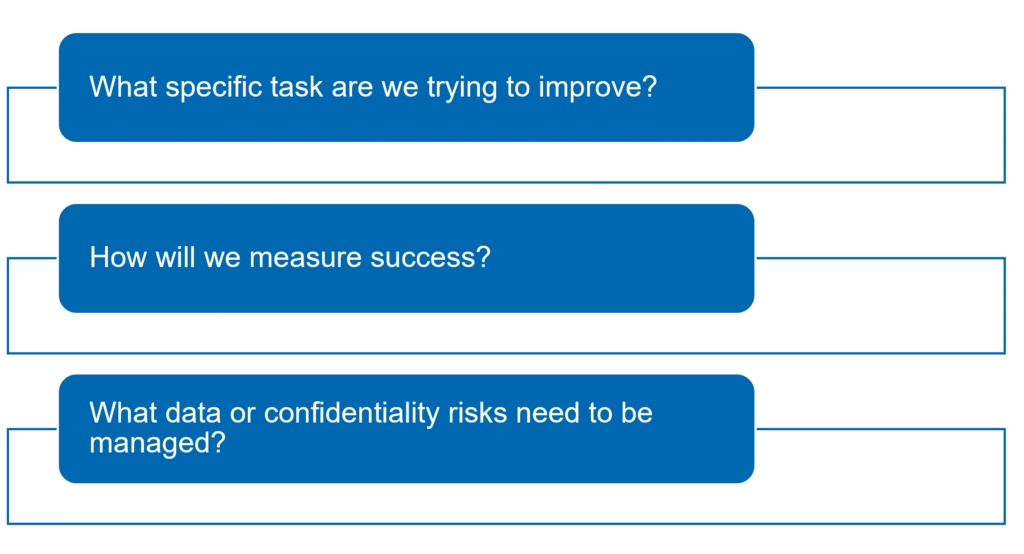
Three questions to ask before implementing AI
At William Buck, we help SMEs identify and implement AI and automation strategies that deliver practical results. If you’d like to explore where technology could create more time and capacity in your business, your local William Buck advisor can guide you through the first steps.