Rate hikes and higher living costs are biting harder in Sydney and Melbourne. Both housing markets moved deeper into decline in April. Price growth eased across all cities, but the slowdown was uneven. Mid-sized capitals saw only a modest loss of momentum and continued to set new record highs.
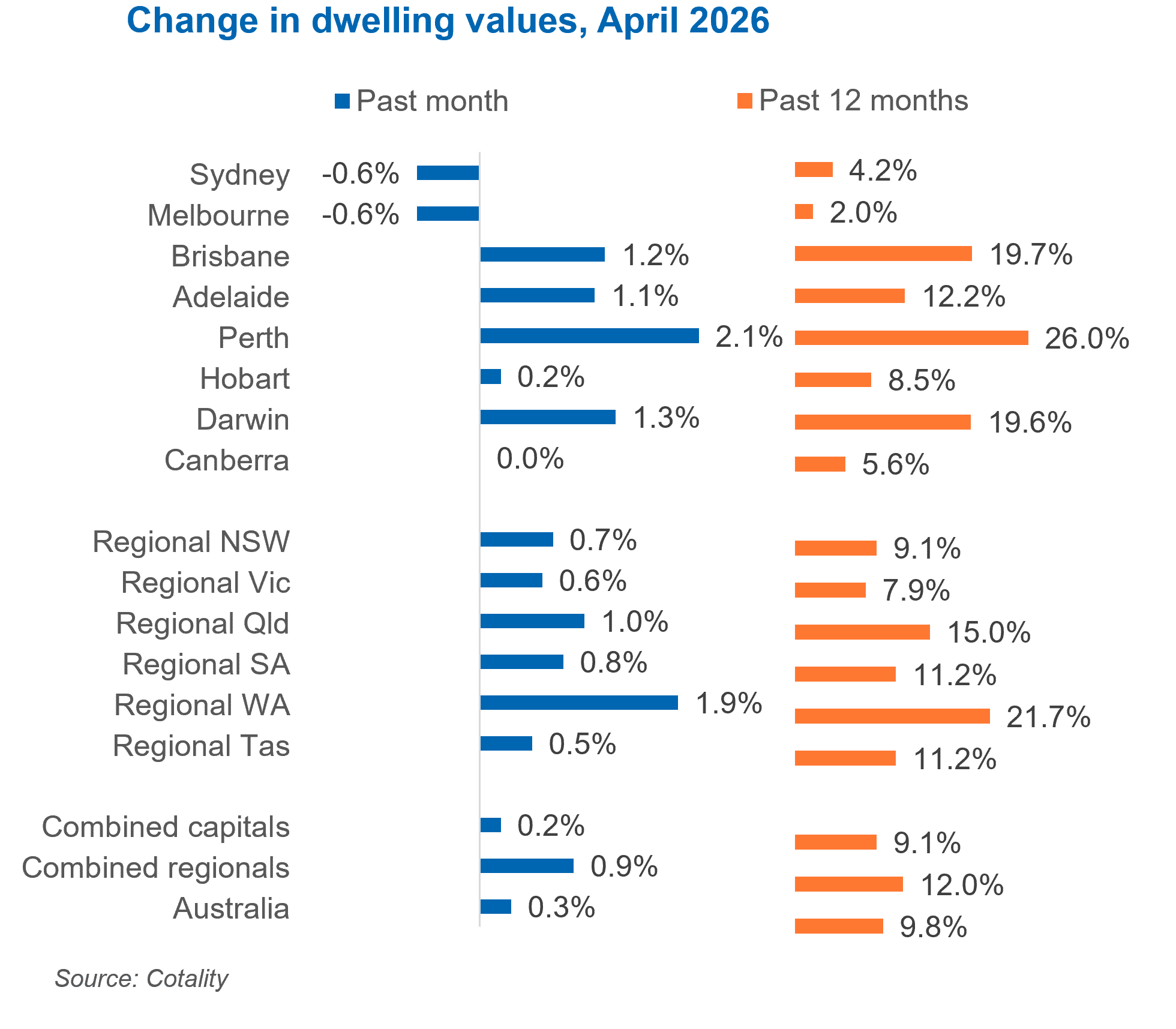
At the national level, dwelling values continued to rise in April, but momentum slowed further. Cotality’s national home value index increased by 0.3% over the month, the slowest monthly pace since January 2025. Annual growth eased to 9.8%, marking a second consecutive month of moderation.
Nationally, house prices rose 0.4% and units 0.3% with annual growth easing for houses to 10.5% but moving a smidgen higher for units to 7.2%. In several cities, annual unit price growth is running ahead of houses, most notably in Perth, Brisbane and Darwin. Buyers continue to turn to units due to lower entry prices as house values remain elevated.
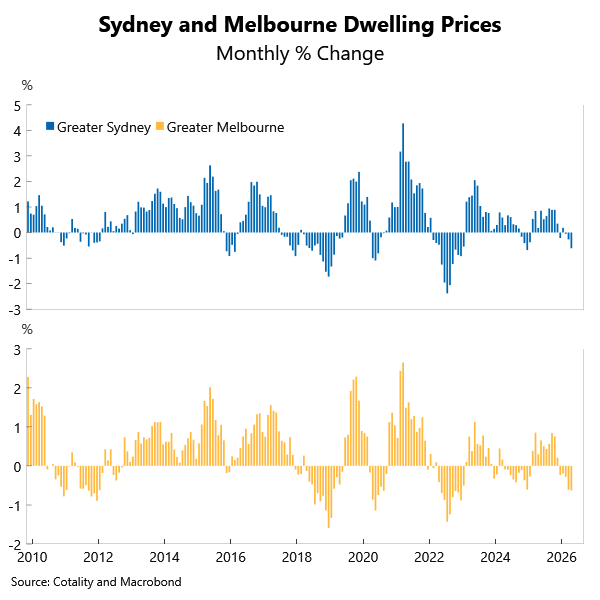
Sydney and Melbourne remain the weakest markets. Dwelling prices fell by 0.6% in Sydney and 0.6% in Melbourne during April. These markets tend to be the most sensitive to higher borrowing costs and shifts in sentiment. Other indicators also point to further softness, including rising listings and persistently low auction clearance rates.
Elsewhere, the picture is far stronger. Perth continues to pull away from the pack. Dwelling prices rose 2.1% in April. Growth cooled from March, but the pace remains solid. And annual dwelling price growth stepped up to 26.0%, the fastest since January 2007.
Brisbane, Adelaide and Darwin also recorded further gains in April, but at a more measured pace. Nevertheless, the home value index pushed to new highs and annual growth rates were high. Brisbane recorded growth of 19.7%, its strongest result since July 2022. Darwin followed at 19.6%, its fastest pace since August 2021, while Adelaide landed at 12.2%, the highest since January 2025.

Competition is strongest in lower value segments, where serviceability constraints and first-home buyer support continue to concentrate activity below the median.
Outlook
Headwinds for housing are hardening, as the prospect of another rate hike next week is high. The slowdown evident in April is likely to continue and the uneven nature of the housing market will persist. Mid-sized capitals are likely to continue outperforming Sydney and Melbourne in the near term, even as momentum eases across all cities.
Policy uncertainty adds another layer of caution. Potential changes to housing-related tax settings in the upcoming Federal Budget may impact sentiment and behaviour. There are yet no clear details, just speculation in the press. At the same time, supply constraints continue to limit downside risk. Construction costs are rising, especially from higher fuel prices and labour shortages are persisting in several cities.
Disclaimer
This report has been prepared for general informational purposes only and does not constitute personal financial advice. It does not take into account your specific objectives, financial situation, or needs. Before acting on any information in this report, you should consider its appropriateness in light of your circumstances and seek independent financial advice. The author holds, or may hold, positions in some of the securities mentioned in this report. These holdings may represent a potential conflict of interest. No representation or warranty is made as to the accuracy, completeness, or reliability of the information contained herein. Past performance is not a reliable indicator of future performance.