International equities
April was a remarkable month for global share markets.
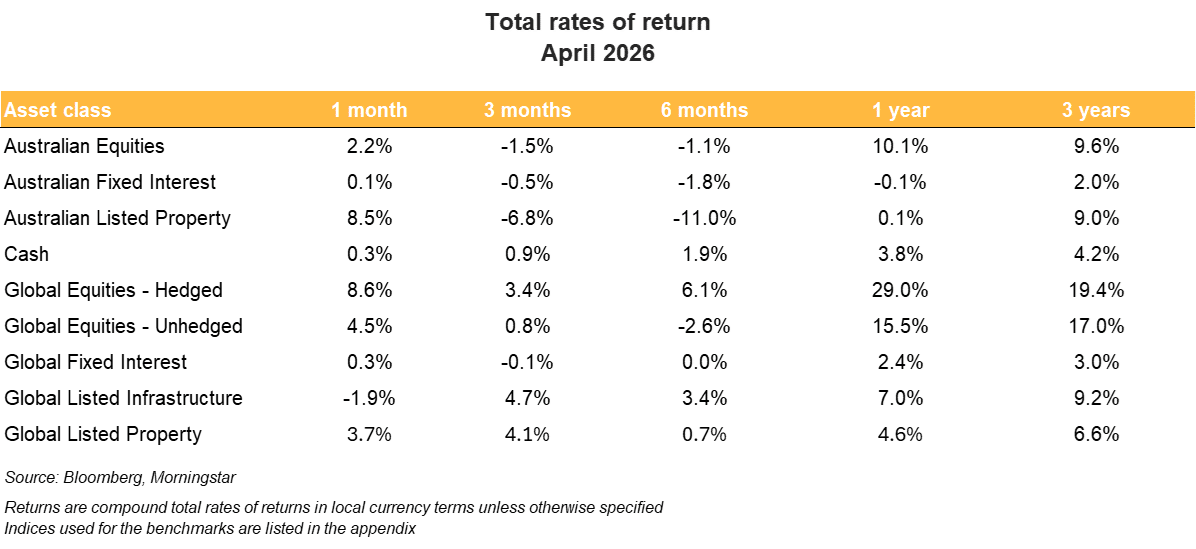
Global equities surged 8.6% in hedged terms and 4.5% in unhedged terms, reversing declines of 5.7% and 2.5% respectively in the previous month. This sharp risk‑on rally unfolded despite the Strait of Hormuz remaining effectively closed and Brent crude oil ending the month 12.4% higher at US$114.01 a barrel. During intraday trading, brent crude actually reached US$126 a barrel, representing its highest level since the war began. The price of urea, a major ingredient in fertiliser, also rose further in April as supply disruptions intensified.
A fragile ceasefire was announced on 7 April, initially supporting the recovery as markets grew more optimistic around a potential resolution to the Middle East conflicts. However, the ceasefire was repeatedly extended as Iran and the US failed to reach a durable peace agreement. Even so, share markets continued to push higher with investor appetite for risk strengthening as the month progressed.
The rally was also driven by a decisive rotation back into AI–linked exposures. The S&P 500 and Nasdaq 100 closed April at record highs, alongside a 14.9% jump in Bloomberg’s Magnificent 7 index. Growth stocks outperformed value decisively, underscoring continued conviction in companies positioned at the centre of the AI investment cycle.
Emerging markets were another clear outperformer. The Morgan Stanley Capital International (MSCI) Emerging Markets Index rose 14.7% over the month (in US dollar terms), led by strong gains in Taiwan and South Korea. These markets benefited from their dominant position within the global AI semiconductor supply chain, reversing the risk‑off moves seen earlier in the year.
Within developed markets, Japan and the US led performance. The Nikkei 225 rose 16.7% in April and the S&P 500 and Nasdaq 100 gained 10.5% and 15.7%, respectively. A strong earnings season across information technology and financials underpinned US equity performance. Excluding Australia, the UK was a laggard. The FTSE All‑Share rose just 2.8%, reflecting greater sensitivity to energy prices and renewed expectations of rate increases from the Bank of England.

|

|
Australian equities
The Australian share market also rose in April, broadly in line with global markets, but fell short of making new highs as seen in the US.
The ASX 300 share market index delivered a return of 2.2% over the month, only partially reversing the 7.3% decline recorded in March, and finished April 5.9% below its record high set on 2 March 2026. Australia’s heavy reliance on imported fuel and fertiliser, alongside growing expectations of further monetary tightening by the Reserve Bank (RBA), continued to weigh on the pace of the recovery. By month end, swap markets were fully pricing two additional rate hikes with a third partially priced.
Market breadth improved materially in April. Seven of the eleven sectors recorded gains last month, a marked shift from February and March when advances were narrowly concentrated. Information technology was the standout, rebounding strongly after prolonged selling pressure earlier in the year and rising 12.3% over the month. In contrast, healthcare remained under pressure and energy retreated after a strong run‑up into April.
Within information technology, eight stocks delivered double‑digit returns, led by Codan (+33.3%) and supported by gains in WiseTech (+12.4%). At the other end of the spectrum, Cochlear (-44.4%) was the weakest performer, dragging the healthcare sector lower after announcing a profit guidance downgrade on 22 April.

|

|
Fixed income and currencies
Global fixed interest delivered a small gain in April with global bonds returning 0.3% and Australian fixed interest up just 0.1%.
Government bond yields rose across most major economies, although the moves were more modest than the sharp repricing seen in March. Elevated yields continued to weigh on duration, limiting capital gains despite improved risk sentiment.
The upward pressure on yields reflected inflation concerns from the surge in energy and fertiliser prices since the conflict broke out in Iran. Energy‑driven inflation pressures were evident across economies. In the US, gasoline futures climbed 13.9% to US$3.77 a gallon, the highest since mid-2022. In Australia, automotive fuel prices rose by 32.8% over the same period. These cost shocks continued to influence inflation expectations into April, contributing to upward pressure on yields even as risk sentiment improved.
Within credit markets, the risk‑on environment saw spreads narrow over the month with high‑yield credit outperforming investment‑grade returns.
Japanese government bonds were the weakest major market, after the Bank of Japan left policy rates unchanged in April while revising its inflation forecasts higher. Combined with Japan’s heavy reliance on imported energy, this led markets to bring forward expectations of further tightening. Consequently, Japanese 10‑year government bond yields increased 17 basis points to 2.52% in April – the highest level since 1997.
In contrast, US bond yields rose more modestly. The US 10‑year Treasury yield increased by 6 basis points in April. Late last month, the US Federal Reserve board met and left the federal funds rate unchanged at 3.50–3.75% and reiterated a wait‑and‑see stance, citing elevated inflation and heightened uncertainty. As a net energy exporter, the US economy is also less exposed to the inflationary impact of higher energy prices than many European and Asian peers.
Australian yields moved higher again. Two‑year government bond yields rose 11 basis points in April, following a much sharper increase of 48 basis points in March. Ten‑year yields increased by 9 basis points, resulting in a further flattening of the yield curve. Both maturities remain well above pre‑conflict levels; 2‑year yields sit around 55 basis points higher, while 10‑year yields are about 36 basis points higher.
Australia entered the conflict already in a tightening phase, as inflation pressures were elevated even before the energy shock. In contrast, the US Federal Reserve and most other major central banks have adopted a more cautious, wait‑and‑see stance amid uncertainty over how inflation and growth risks will evolve. This policy divergence has widened the gap between Australian and US short‑dated yields, providing support for the Australian dollar.
Amid the improvement in risk appetites, the Australian dollar rose to a near four‑year high of US$0.7222 on 17 April and closed the month near that level at US$0.7201, representing a 4.4% gain over April. The move was also aided by a 1.9% decline in the US dollar index. The local currency strengthened sharply against the Japanese yen as well, with USD/JPY breaching the 160 level late in April, prompting Japanese authorities to intervene and driving the pair sharply lower. AUD/JPY rose from 109.52 at the end of March to 112.77 at the end of April.
Overall, the Australian dollar’s appreciation was broad‑based. In trade‑weighted terms, it rose 3.1%, underpinned by higher commodity prices and expectations of further monetary tightening by the RBA.


Property and infrastructure
Listed property rebounded sharply in April after the severe sell‑off in March, as risk appetite returned across equity markets.
Bond yields continued to rise but did so at a slower pace than in March, allowing valuation‑sensitive real‑estate assets to recover part of their earlier losses. Australian listed property rose 8.5% over the month, while global listed property gained 3.7%, following respective declines of 11.2% and 5.6% in March.
Despite the rebound, performance remains highly sensitive to interest‑rate expectations and elevated bond yields. Bond markets did not deliver a meaningful easing in financial conditions during April, limiting the scope for valuation re‑rating. As a result, the recovery reflected improved sentiment and positioning rather than a fundamental shift in the rate backdrop.
Listed infrastructure again outperformed on a relative basis. More stable earnings profiles, inflation‑linked revenues and long‑dated contracted cash flows continued to attract investor interest. The asset class participated in the broader equity recovery while remaining less exposed to valuation pressure from higher bond yields than listed property.
Outlook
The ceasefire between Iran and the US remains fragile.
Markets are currently adopting a half‑glass‑full view, pricing in an expectation that the conflict will not return to the intensity seen in March. That optimism, however, hinges on unresolved questions around sequencing. The key issue is whether the blockade is lifted first or the Strait of Hormuz is reopened first, as both Iran and the US will seek to shape the narrative and avoid appearing to concede ground.
As long as negotiations remain unresolved, risks to the global outlook continue to build. Energy supply disruptions are persisting, inventories of oil and refined fuels are being drawn down, and the scope for further dislocations remains elevated. While risk sentiment improved through April, markets remain highly sensitive to conflict‑related headlines. Volatility is therefore likely to remain a defining feature of the near‑term environment.
In Australia, inflation dynamics have become more challenging. Underlying inflation rose to 3.5% in the March quarter, while headline inflation jumped to 4.1%, its highest level in more than two years. The monthly indicator climbed to 4.6%. Fuel prices accounted for most of the March quarter increase, but the inflation impulse is expected to broaden in the June quarter as second‑round effects flow through. The conflict has clearly amplified the Reserve Bank’s task at a time when inflation was already above target. The longer the conflict remains unresolved, the greater the inflation challenge for the RBA and the higher the risk that growth slows sharply.
More broadly, recent developments reinforce the structural shift toward a more fragmented global economy. Trade and supply chains are increasingly shaped by strategic leverage or chokepoints rather than shared interests or shared efficiency. Disruptions to shipping routes, the subsequent imposition of export restrictions on refined fuels and other critical inputs, and rising defence spending all point to a world that is structurally more inflation‑prone than the pre‑pandemic period. While the AI revolution may deliver productivity gains over time, the scale and timing of any offset remains uncertain.
Against this backdrop, investors need to continue to place greater emphasis on inflation risk than they did in the decade prior to the pandemic. Portfolio construction should place a higher premium on resilience, real return outcomes, liquidity and balance‑sheet strength. Selectivity across asset classes will be increasingly important as headline returns become more episodic and sensitivity to macro shocks rises.
Domestically, the policy outlook has tightened materially. The Reserve Bank delivered consecutive rate increases in each of its meetings in February, March and May. It has now taken the cash rate to 4.35%, matching the peak of the previous tightening cycle. The risk of an additional increase remains, and we see the terminal rate potentially extending to 4.60% should inflation pressures remain persistent. At the same time, growth momentum is slowing. We expect GDP growth to ease to 1.4% this year, while the unemployment rate rises toward 4.7%. Moreover, we do not expect a return to the RBA’s inflation target band until next year.
Fiscal policy may add another layer of uncertainty. The Federal Budget on 12 May is expected to include significant tax measures, particularly in relation to housing. Possible changes to the capital gains tax (CGT) discount and the treatment of negative gearing remain under discussion.
Disclaimer
This report has been prepared for general informational purposes only and does not constitute personal financial advice. It does not take into account your specific objectives, financial situation, or needs. Before acting on any information in this report, you should consider its appropriateness in light of your circumstances and seek independent financial advice. The author holds, or may hold, positions in some of the securities mentioned in this report. These holdings may represent a potential conflict of interest. No representation or warranty is made as to the accuracy, completeness, or reliability of the information contained herein. Past performance is not a reliable indicator of future performance.