Today, we received an update on economic activity in the June quarter, a period marked by ongoing conflict in the Middle East, elevated uncertainty and a third rate hike from the Reserve Bank (RBA) in May.
The economy grew by 0.4% in the June quarter, matching the pace recorded in the March quarter. Annual growth slowed from an upwardly revised result of 2.9% in the March quarter to 2.1% last quarter.
Growth is easing, but the brakes are not biting hard enough. Economic activity remains slightly above the economy’s estimated speed limit and is stronger than the RBA’s forecast, raising questions about whether demand is slowing sufficiently to bring inflation back to target.
Perhaps policymakers are driving with worn brakes. The impact of three rate rises is clearly being felt, but not enough to deliver the slowdown they are seeking. The analogy seems particularly apt given household spending continued to help drive growth in the June quarter. Household consumption rose 0.4% in the quarter with more than half of the increase coming from discretionary items. What stood out was spending on electric and hybrid vehicles, which climbed to a record high as households sought to reduce ongoing transport costs.


The household savings ratio nudged up to 6.5% in the June quarter, from 6.4% in the March quarter, alongside a 0.6% lift in real household disposable income. These savings provide households with a buffer and could support stronger spending at some stage, but consumers remain cautious for now. This caution may not disappear in a hurry, particularly given elevated levels of uncertainty.
Residential construction, public demand and net exports also added to growth in the quarter, while private investment detracted from growth. Private business investment was impacted by a pullback in spending on data centres, falling 5.6% last quarter, the biggest decline in six years. However, it followed a rise of 15.4% in the March quarter, the largest increase in 23 years. Investment in data centres is inherently lumpy and volatile.
The way we see it, the RBA has one of two choices. It can continue to sit on its hands and wait to see how the data evolves from here. It may be willing to tolerate inflation remaining above target for longer if it believes a slower return to the band avoids an unnecessarily sharp rise in unemployment. It may see the deepening downturn in the housing market as a means of dampening household spending growth and, in turn, reducing inflationary pressures. It may also be reassured by unemployment creeping higher, although there are still elements of resilience when one scratches beneath the surface of the labour market. Further, it takes time for rate hikes to fully work through the economy. That is, the three rate hikes delivered earlier this year have still not finished their job.
However, the minutes of the last Board meeting revealed policymakers remain concerned about the upside risks to inflation and the labour market is still likely to be characterised as somewhat tight. Moreover, the latest monthly inflation data revealed continued persistence in services inflation. The conflict in the Middle East means oil prices are likely to remain volatile and supply-chain disruptions could intensify. The longer inflation remains above target, the greater the risk that it becomes more difficult to rein in. For this reason, we cannot rule out one more rate hike.
Earlier this week, we reinstated our forecast for one more rate hike this year with the timing being next month. It is not a call we hold with high conviction. It is a close call. However, households and small businesses should factor in the possibility of another rate rise when setting budgets, something we have continued to stress. We think one more would be enough. Swap markets are less convinced and are only partially priced for two rate hikes from here.
The inflation and productivity measures in the national accounts data are worth watching for the clues they provide about business conditions and the outlook for interest rates. The GDP implicit price deflator (IPD) and domestic final demand IPD rose by 0.7% and 0.5%, respectively, in the June quarter. The annual rates stand at 3.0% and 3.1%, both representing an acceleration from the pace recorded in the previous quarter.
Productivity, measured by GDP per hour worked, was flat in the June quarter and down 0.2% over the year, a disappointing outcome. Unit labour costs (ULCs), a key focus of the RBA, rose a solid 0.9% in the quarter, but on a year ago was still soft at 0.5%.
States
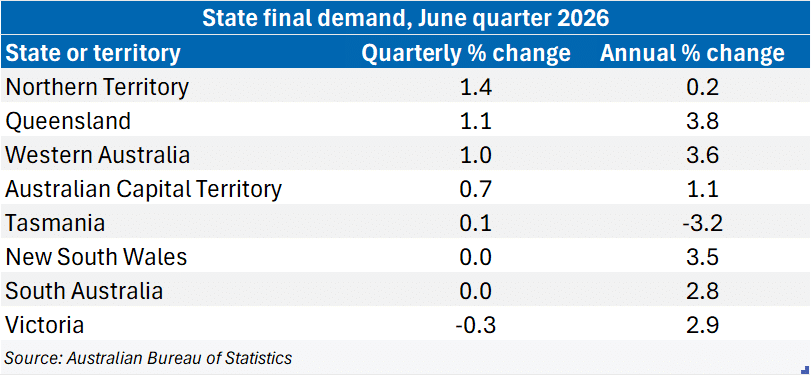
Growth was uneven across the states and territories. Four of the eight recorded growth, led by Queensland and Western Australia. Queensland state final demand, which excludes the external sector, surged 1.1% in the June quarter and 3.8% over the year, the fastest annual pace in more than two years.
State final demand fell in Victoria by 0.3%, while no growth was recorded in either New South Wales or South Australia.
Industries
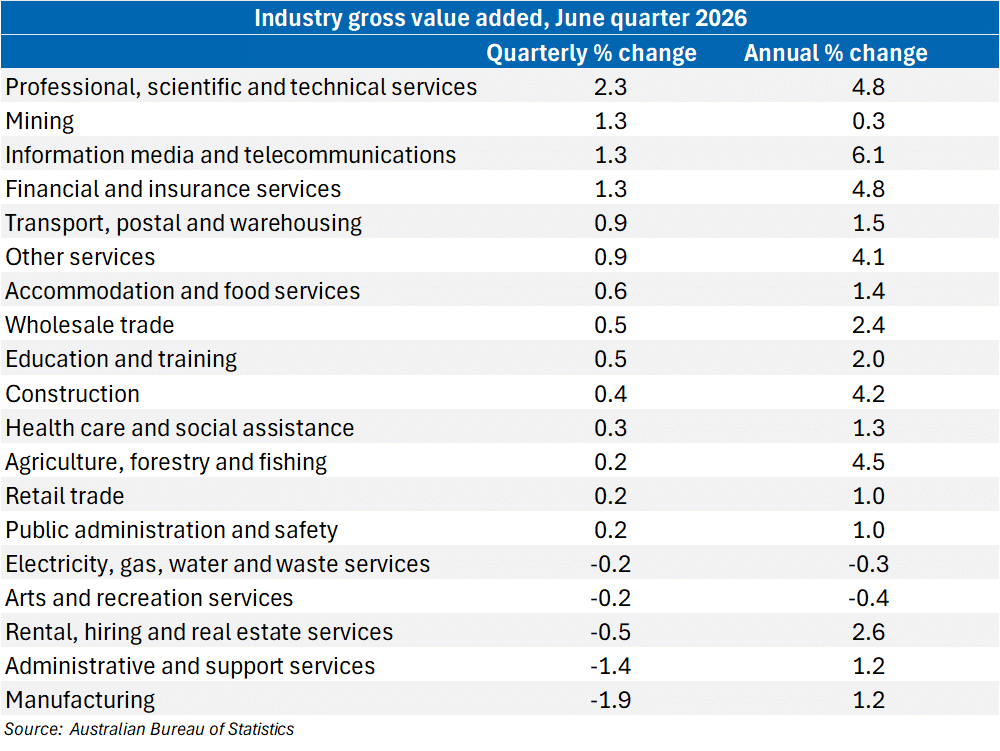
Across industries, 14 of 19 industries recorded an expansion in activity. The pullback in data-centre investment, which was a feature of the business investment data, appears to have contributed to weaker activity in manufacturing. Manufacturing production fell 1.9% in the June quarter, the largest decline of all 19 industries.
The strongest-performing industry in the June quarter was Professional, Scientific and Technical Services, which benefited from ongoing demand for engineering design, management consultancy and digital AI services. It rose 2.3%.
Financial and insurance services, information media and telecommunications, and mining, led by coal production, also delivered strong gains of 1.3% each in the quarter.