This inflation report is the final update on prices before the RBA Board meets again in September. The minutes of the August meeting, released yesterday, showed a Board that wants to wait and see how the data evolves, but one that also remains alert to upside risks to inflation. That made today’s report particularly important.
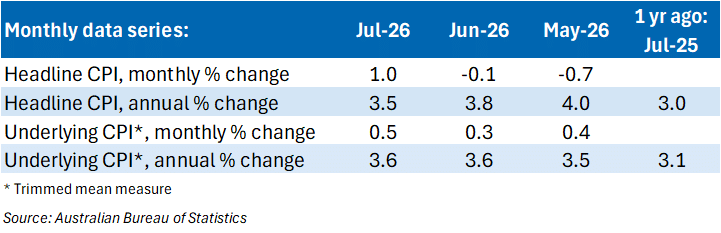
Underlying inflation rose by 0.5% in July, the strongest monthly increase in a year. The annual trimmed mean rate, however, remained unchanged at 3.6%. While the annual trimmed mean rate remained steady, recent inflation outcomes have been stronger than the annual measure alone suggests. For example, on a three-month annualised basis, underlying inflation is running at 4.7%, highlighting that price pressures have remained brisk over recent months.


While there is still time for inflation to moderate over the remainder of the year, today’s data is likely to keep the Board alert to the risk that inflation proves more persistent than expected. The RBA is forecasting underlying inflation to slow to 3.3% by the end of 2026. There’s still time for inflation to ease, but today’s data may do little to alleviate the concerns about upside inflation risks held by some Board members.
Meanwhile, headline inflation rose 1.0% in the month whilst easing from 3.8% in June to 3.5% in July in annual terms.
Seven of the eleven inflation groups recorded annual inflation above the upper end of the RBA’s 2-3% target band, down only modestly from eight in June.
Housing continues to record the strongest annual rate of inflation, although growth slowed to 5.0%, its weakest pace in almost a year. While the easing in housing inflation is encouraging, inflation pressures will need to narrow further before policymakers can be confident that inflation is returning sustainably to the target band.
Goods and services prices each rose 0.6% in July. On an annual basis, however, services inflation remains stronger at 3.8%, compared with 3.2% for goods. This is unlikely to escape the RBA’s attention given services inflation has generally proven more persistent and is more closely linked to domestic demand and labour market conditions.
The latest figures reinforce the message from the Board’s latest minutes that upside inflation risks remain. The stronger monthly underlying inflation outcome and the breadth of price pressures across the economy will keep policymakers on alert.
For businesses, the environment remains challenging, with cost pressures still elevated at a time when softer demand is making it harder to pass those costs on. As a result, margin pressures are likely to remain a feature of the economic landscape for some time yet.