Dwelling prices nationally declined 0.9% in August, representing the fifth consecutive monthly decline. Houses continue to bear the brunt of the downturn with values falling 1.1% over the month compared with a 0.5% decline for units. Annual dwelling price growth has slowed to 2.7%, the weakest pace in three years, while national dwelling values are now 3.6% below their March 2026 peak.
The housing downturn has become deeper and broader based. Only Darwin, regional WA and regional SA were immune to price falls last month. Furthermore, according to Cotality, 93% of homes recorded price declines during the three months to August (i.e. winter), highlighting just how widespread the downturn has become.
The largest falls in August were again recorded in Sydney (-1.4%), Melbourne (-1.1%) and Canberra (-1.1%). In year-on-year terms, the biggest falls were also in Melbourne (-4.7%) and Sydney (-4.6%).


Despite the recent weakness, it is important not to lose sight of the longer-term picture. National dwelling prices remain almost 24% higher than they were five years ago and approximately 67% higher than a decade ago.
Typically, the onset of spring marks the beginning of the housing market’s busiest period, with increased listings and stronger buyer activity. This year, however, buyer sentiment remains soft. The Melbourne Institute’s measure of whether it is a good time to buy a dwelling has improved modestly since reaching a recent trough in May, but remains below the important threshold level of 100. In other words, households continue to view housing market conditions pessimistically.
Other indicators also suggest housing conditions continue to deteriorate. Auction clearance rates remain weak across most markets and point to further softness in dwelling prices in coming months. At the same time, properties are taking longer to sell, while listings are accumulating as buyers become increasingly cautious.
A key challenge for the housing market is that affordability has deteriorated substantially following several years of strong price growth and higher mortgage rates. Borrowing capacity has been materially reduced, limiting the ability of many households to enter the market. At the same time, the Federal Budget’s changes to investor taxation have weakened the investment case for established housing. Investors have historically provided an important source of demand during housing upswings, particularly in Sydney and Melbourne, and reduced participation from this segment is likely to weigh on housing activity for some time.
The outlook for interest rates remains highly uncertain. The question of whether the RBA delivers one more rate hike this cycle remains finely balanced. We moved to an on-hold view in July, but the latest inflation data suggests underlying inflation remains sticky and recent RBA rhetoric indicate policymakers remain concerned about upside inflation risks.
Financial markets continue to favour another rate increase later this year, largely on the view that the RBA will want to assess the September quarter inflation data before taking further action. However, if the Board is genuinely concerned that inflation is proving more persistent than expected and that its return to target may be delayed, there is a reasonable argument for moving sooner rather than later. We have, therefore, shifted our call to one further increase next month, although we hold this view with limited conviction. It remains a very close call.
Households with debt should continue budgeting for at least one more increase in borrowing costs and remain mindful of elevated levels of uncertainty in the economy. Small businesses should also pay close attention to developments in the housing market. Housing downturns are often associated with slower growth in household spending as declining housing wealth weighs on confidence and discretionary expenditure. While we have reservations about the monthly household spending indicator, national accounts data continue to show a clear relationship between housing market conditions and consumer spending growth. Slower spending growth would place pressure on business revenues.


Notwithstanding the weaker demand environment, Australia continues to face an underlying shortage of housing. Population growth has moderated from the extraordinary post-pandemic surge but remains supportive of housing demand. At the same time, construction activity remains insufficient to close the housing supply gap.
While building approvals have recovered from their lows and have moved higher over the past year, approvals remain below the pace required to meet the government’s housing targets. More importantly, dwelling commencements have not kept pace with approvals, reflecting ongoing challenges around construction costs, labour shortages and project feasibility. Elevated building costs and uncertainty around inflation and interest rates continue to hinder new supply, with some projects delayed or shelved altogether.
This creates an unusual backdrop for the housing market. Supply constraints should help limit the magnitude of the downturn and reduce the risk of a more significant correction. However, in the near term, they are being outweighed by weaker demand driven by higher interest rates, deteriorating affordability and reduced investor activity. At present, the demand-side headwinds are winning.
Forecasts
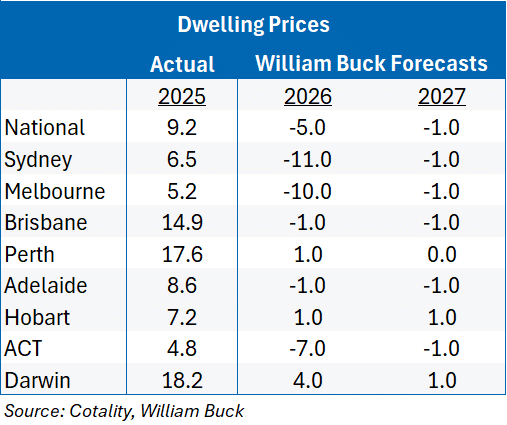
As a result, we have revised our housing forecasts lower. We now expect national dwelling prices to decline by 5% in 2026, compared with our previous forecast of a 3% fall. We anticipate the largest declines will occur in Sydney (-11%) and Melbourne (-10%), where affordability pressures are most acute and housing demand is most sensitive to interest rates.
Looking ahead to 2027, we expect housing conditions to gradually stabilise as markets begin to look ahead to eventual RBA rate cuts. However, we do not expect this to be sufficient to generate a broad-based recovery next year. Higher mortgage rates, affordability constraints and weaker investor participation following the tax changes are likely to remain significant headwinds. While Australia’s housing shortage should provide some support to prices, we expect national dwelling values to fall a further 1% in 2027 before a more meaningful recovery emerges thereafter.
Disclaimer
This report has been prepared for general informational purposes only and does not constitute personal financial advice. It does not take into account your specific objectives, financial situation, or needs. Before acting on any information in this report, you should consider its appropriateness in light of your circumstances and seek independent financial advice. The author holds, or may hold, positions in some of the securities mentioned in this report. These holdings may represent a potential conflict of interest. No representation or warranty is made as to the accuracy, completeness, or reliability of the information contained herein. Past performance is not a reliable indicator of future performance.