International equities
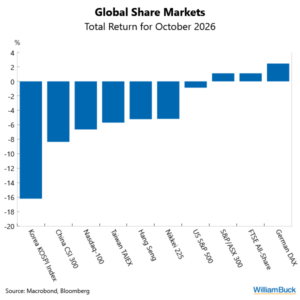
International equity markets came under pressure in October with weakness concentrated among some of the largest AI-related companies.
Global equities declined in both hedged and unhedged terms over the month and the sell-off extended into early November with unhedged portfolios experiencing larger falls. In the US, the reversal has been particularly pronounced. The Nasdaq and S&P 500 reached record highs on 6 October but, as at the close on 5 November, were nearly 12% and 6% below their respective peaks.
 |
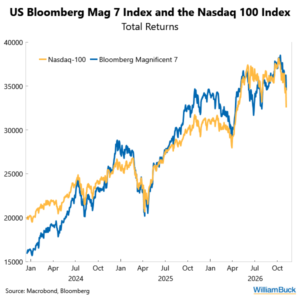 |
The change in sentiment has been particularly pronounced across the AI trade. Investors have become more cautious about valuations and increasingly focused on whether the enormous investment in AI infrastructure will generate sufficient earnings and cash flow. Neocloud companies, which provide computing infrastructure for AI, have been particularly vulnerable as attention has shifted from strong demand to the cost and sustainability of financing their expansion. Third-quarter US corporate earnings were generally resilient, but investors became less willing to reward investment in AI without a clearer path to returns. Companies reliant on continued rapid infrastructure spending or significant debt financing came under the greatest pressure, while some defensive sectors provided an offset.
The US midterm elections added another layer of volatility in early November. Democrats won control of both chambers of Congress and will assume those majorities when the new Congress is seated in January 2027. The result will constrain President Trump’s ability to advance legislation without Democratic support, although the President retains substantial executive powers. US equities initially rallied following the election, but the rebound proved short-lived. Selling intensified again, as investors reassessed the outlook for AI and data-centre investment (including regulation), reinforcing the broader shift towards greater scrutiny of valuations and capital spending.
Asian share markets were not immune. South Korea was among the hardest-hit markets while key indices across Greater China also recorded sizeable declines. The broader Morgan Stanley Capital International (MSCI) Asia Pacific ex Japan Index fell 6.8% in October.
Geopolitical developments added to the uncertainty confronting equity markets. Brent crude traded above US$100 a barrel for much of October and reached a six-month high of US$118 ahead of the US midterms, amid tanker attacks, Houthi strikes on Saudi Arabia and concerns about a further escalation of the conflict involving Iran. Brent averaged US$108.34 a barrel in October, 6.2% higher than in September, before falling under US$100 a barrel in early November.
Higher energy prices are adding to upside risks to inflation and complicating the outlook for monetary policy. The Bank of Canada was the only major central bank to raise rates in October. The Reserve Bank of Australia (RBA) and the UK’s Bank of England followed with rate hikes in early November. The US Federal Reserve and central banks in the Eurozone, Japan and New Zealand are expected to tighten policy further in coming months. While higher interest rates, geopolitical uncertainty and caution towards the AI trade remain headwinds, still resilient corporate earnings and strength in other parts of the equity market are providing some support.
Australian equities
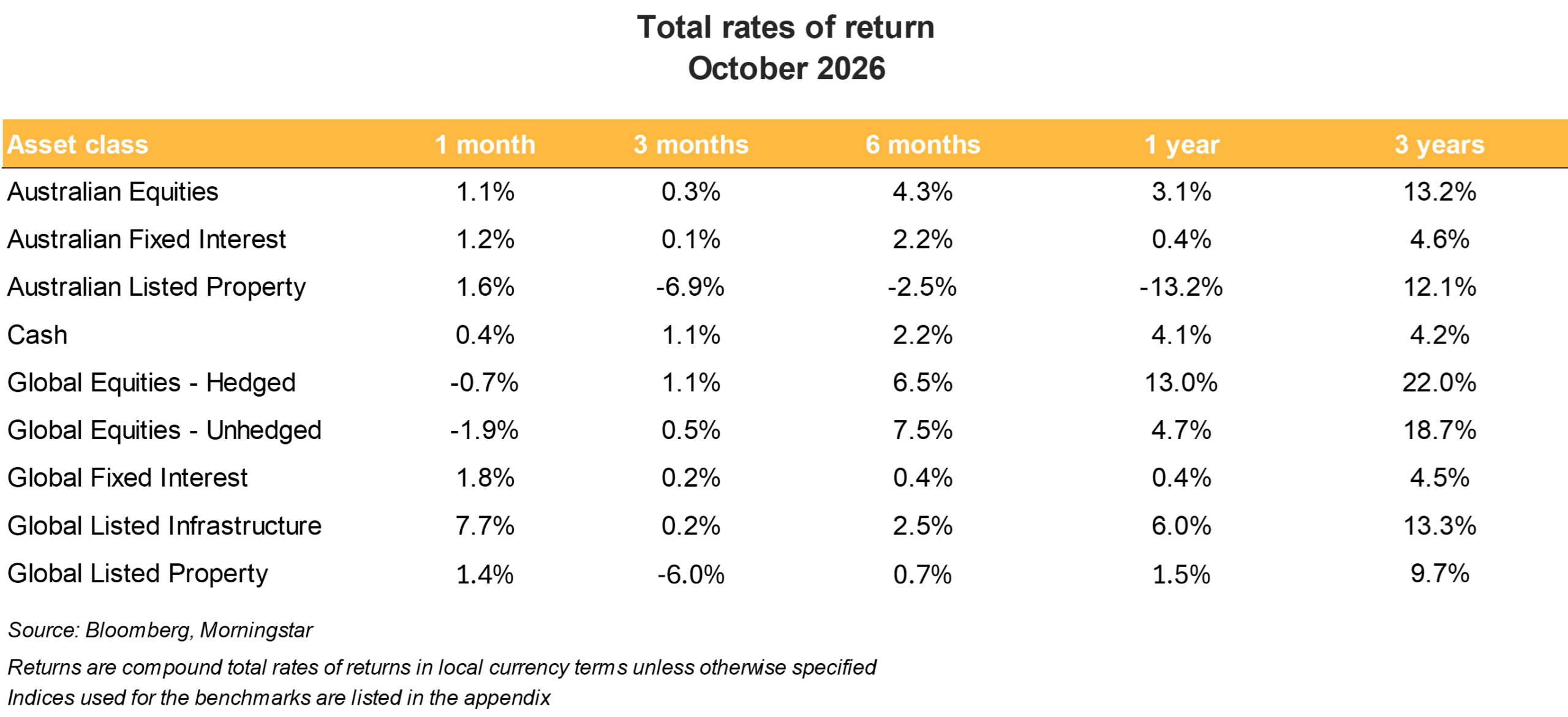
Australian equities returned 1.1% in October amid heightened volatility. The market has faced selling pressure since the S&P/ASX 300 reached a record high in August, falling to a near four-month low on 1 October before recovering through the remainder of the month.
Volatility carried into early November. Australian equities rallied strongly following the US midterm elections before pulling back in early trading on 6 November.
Monetary policy remained an important influence on investor sentiment. The September-quarter inflation data, released on 28 October, cemented expectations of another RBA rate rise, which was delivered on 3 November. The RBA raised the cash rate by 25 basis points to an 18-year high of 4.85%, while its accompanying Statement on Monetary Policy materially upgraded the inflation outlook, lowered its forecasts for economic growth in 2027 and projected a weaker labour market. Inflation is now expected to remain above the top of the target band until late 2027, longer than previously forecast. However, the decision to raise rates was split 6–3, suggesting the hurdle for further tightening has increased. In addition, the RBA reiterated its commitment to returning inflation to target, but dropped the explicit reference to the possibility of raising the cash rate further.
 |
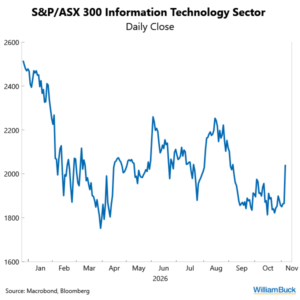 |
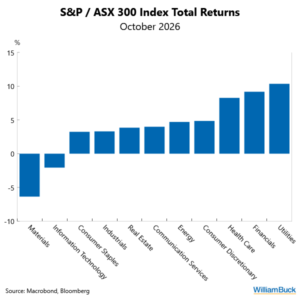
Beneath the headline share market index, performance varied. Utilities and financials were among the stronger performers, while materials and information technology were the only sectors to decline. The weakness in technology came amid growing investor scrutiny of the AI and data-centre investment boom. Firmus Technologies abandoned its planned ASX listing on 9 October after the offer failed to attract sufficient investor demand. Concerns were centred on its valuation, debt and the scale of investment required to fund its expansion.
Caution around AI intensified later in the month when NEXTDC sharply downgraded its FY27 outlook. The downgrade reflected delays to electricity network upgrades at its M3 data centre in Melbourne, which pushed additional power capacity into financial year 2028. NEXTDC shares plunged 41.7% on 21 October, wiping nearly $3 billion from its market value in its worst trading day since listing. The shares subsequently rebounded sharply, highlighting the extreme volatility surrounding AI-related infrastructure investments.
Investor scrutiny of the technology sector has continued into November. Privately-owned Australian technology company Canva announced a major restructure earlier this week, affecting around 1,270 employees or 22% of its workforce. The restructure followed a slowdown in Canva’s growth and comes as rapid advances in AI reshape the technology sector, although the company did not explicitly attribute the job losses to AI.
Materials were the other area of weakness, as softer base-metal prices weighed on mining stocks. The LMEX index, which tracks a basket of base metals traded on the London Metal Exchange, fell 2.2% in October and weakened further in early November.
Fixed income and currencies
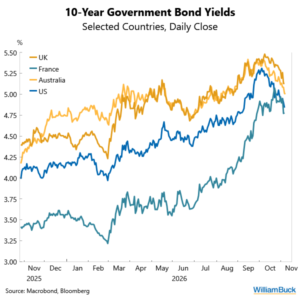
Government bond yields fell sharply in October and the bond rally extended into early November, reversing part of the substantial increase in yields seen earlier in the year.
The move occurred despite elevated energy prices and persistent inflation concerns, as growing caution around the outlook for technology stocks and parts of the AI investment boom encouraged investors to rotate towards safer assets. US government bonds led the rally (i.e. yields fell the most). US 2-year Treasury yields fell by 30 basis points in October and declined further in early November, while 10-year yields fell from 5.29% at the end of September to 4.94% at the end of October and 4.84% by 5 November.
Australian government bond yields also declined, although by less than in the US. At the long end of the curve, the 10-year government bond yield closed at 5.41% on 7 October, just shy of September’s peak, the highest level since May 2011. From there, yields fell sharply over the remainder of the month and into early November, ending October at around 5.13% before falling further to around 5.0% by 5 November.
The Australian bond rally gathered pace following the RBA’s November meeting when the Board lifted the cash rate by 25 basis points to 4.85%. Importantly, the decision was split 6–3 with three members preferring to leave rates unchanged while the statement dropped September’s explicit reference to raising the cash rate further “if needed”. RBA Governor Michele Bullock also subsequently suggested it was “probably” a good time for the Board to take stock after five increases this year. Together, these developments suggest the hurdle for another increase has risen, although the RBA continues to judge inflation risks as skewed to the upside.
Our central view is that the November increase will mark the peak in the cash rate, although we attach around a 30% probability to further tightening next year. Persistent domestic inflation pressures mean another increase cannot be ruled out, particularly if services inflation or inflation expectations prove stronger than expected. The RBA has emphasised that weak productivity growth has constrained the economy’s capacity to grow without generating inflation and that domestic capacity pressures have been stronger than previously assessed. Our base case is that the next move will instead be a rate cut late in the September quarter of 2027, as the cumulative effect of restrictive monetary policy increasingly weighs on demand, employment and inflation.
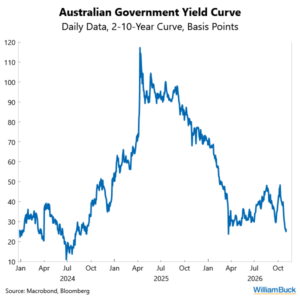
The Australian 2-10-year yield curve has flattened, as markets weigh weaker growth against still elevated inflation. The RBA expects monetary tightening and weaker housing conditions to keep GDP growth below trend, with unemployment rising further over the forecast period.
The decline in longer-term government bond yields was broad-based across advanced economies. By 5 November, 10-year yields were below their end October levels in the US, Australia, Germany, the UK, Canada and Japan. France was the notable exception to the broader bond-market rally during much of October. French government bonds sold off sharply as political, social and fiscal concerns intensified, sending the 10-year yield to 24-year highs above 5% during the month even as US and German yields were falling. The divergence became sufficiently pronounced to encourage some safe-haven flows into US Treasuries and other sovereign bond markets. French yields subsequently retreated with the 10-year trading below 5% again in early November.
So far, spillovers from France to other European sovereign and corporate credit markets appear contained, although renewed stress could drive further flows towards markets with stronger public finances. The next major test will be France’s 2027 budget, which the government is seeking to secure parliamentary approval for by the end of December amid a fragmented parliament.
Global credit markets were relatively resilient in October. In Australia, investment-grade credit spreads widened modestly before retracing much of the move in early November. In the US, high yield posted a small gain, although investors became more discerning as concerns grew around debt-funded AI investment and whether future earnings will justify the additional borrowing.
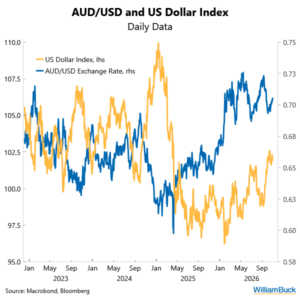
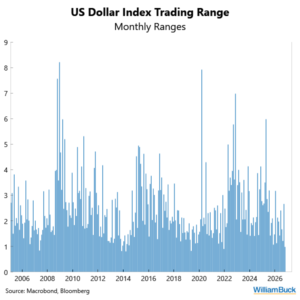
The Australian dollar gained ground against most major currencies in October, rising 0.8% in trade-weighted terms. This included gains of 1.2% against the US dollar, 2.8% against the euro, 1.8% against the Japanese yen and 0.3% against the British pound. The AUD/USD exchange rate reached a one-month high of US$0.7068 on 29 October, before selling off sharply in early November to trade at around US$0.6930, a three-week low. The US dollar, meanwhile, remained within a relatively narrow range through October and into November, recording a modest gain in October before giving back that increase in early November.
Property and infrastructure
Listed property and infrastructure recovered from September’s weakness, returning 1.6% and 1.4%, respectively, in October.
Falling bond yields provided a tailwind for both asset classes, as lower discount rates increased the relative attractiveness of their long-dated income streams and supported valuations.
Global listed infrastructure was the standout, returning 7.7% in October and ranking as the strongest-performing asset class over the month. Over a longer one-year horizon, however, global equities remained the stronger performer, highlighting the particularly strong run in equity markets despite October’s rotation towards more defensive and income-oriented assets.
Outlook
The past month has reinforced the value of diversification, both across and within asset classes.
Weakness was most pronounced among some of the largest technology companies, although the broader US equity market also declined. The rally in high-quality government bonds provided an offset to equity-market weakness.
The economic backdrop remains broadly supportive, particularly in the US where activity has remained resilient and investment continues to benefit from the expansion in AI-related capacity. The challenge is that inflation remains persistent in the advanced economies, limiting the scope for central banks to ease policy.
In Australia, we expect this week’s RBA increase to mark the peak in the cash rate, although the risk of another hike has not fully disappeared. Market pricing has shifted in the same direction, with expectations of further tightening pared back following the November RBA meeting and some prospect of rate cuts being priced later in 2027. That pricing could change quickly, however. Incoming inflation, labour-market and activity data will ultimately determine whether expectations continue to move towards eventual easing or swing back towards further tightening.
At the same time, the investment case for AI is entering a more demanding phase. The long-term opportunity remains significant, but the focus is increasingly moving from how much companies are spending to the returns that investment can generate. This matters because AI infrastructure is not competing for capital in isolation. Governments continue to borrow heavily and investment requirements across infrastructure, energy and defence remain substantial, creating competing demands for funding while the cost of capital remains relatively high. The pressure seen in French sovereign bonds and parts of the AI-related credit market during October illustrates how quickly financing conditions can change when investors become uncomfortable with leverage, fiscal positions or the prospective return on investment.
For investors, the message is not to step away from risk, but to diversify where that risk is taken. Economic growth and corporate earnings remain supportive, although stretched valuations, sticky inflation and increasing demands on global capital raise the consequences of getting the investment call wrong. Spreading exposure across markets, sectors and factors such as Value stocks can help reduce dependence on the recent market leaders. At the same time, the appeal of high-quality fixed income is arguably increasing, offering attractive income as well as the potential to cushion portfolios when equity markets come under pressure.
Appendix
Disclaimer
This report has been prepared for general informational purposes only and does not constitute personal financial advice. It does not take into account your specific objectives, financial situation, or needs. Before acting on any information in this report, you should consider its appropriateness in light of your circumstances and seek independent financial advice. The author holds, or may hold, positions in some of the securities mentioned in this report. These holdings may represent a potential conflict of interest. No representation or warranty is made as to the accuracy, completeness, or reliability of the information contained herein. Past performance is not a reliable indicator of future performance.