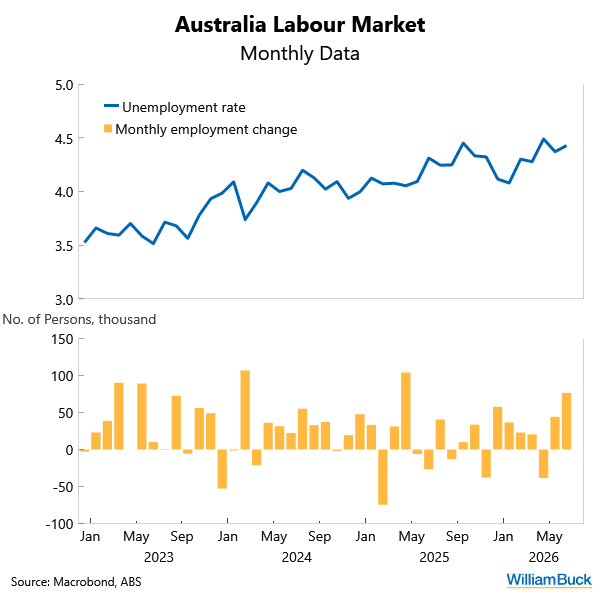
The resilience of the Australian labour market remains a striking feature of the economy. The unemployment rate held steady at 4.4% in June and employment rose by 76.3k, the largest monthly increase in 14 months. The gain was driven by a sharp lift in part-time employment, which increased by 47.0k, while full-time employment also rose by a solid 29.3k.
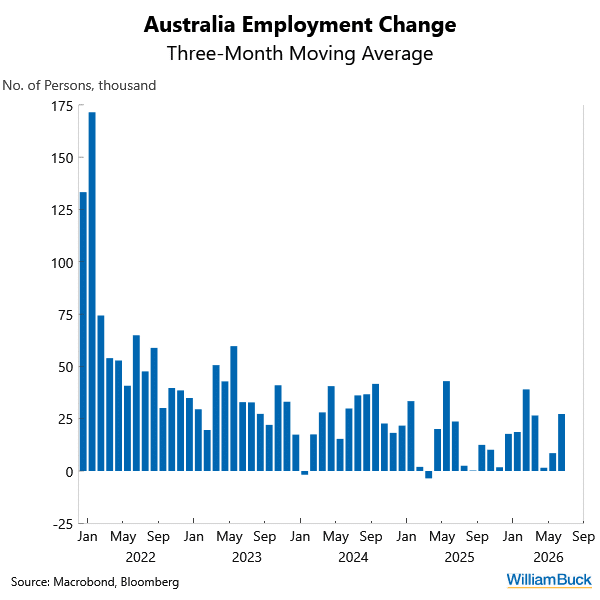
Monthly employment data can be volatile, which means too much weight should not be placed on a single result. Looking through the monthly fluctuations helps provide a clearer picture of underlying labour market momentum. The three-monthly moving average for total employment picked up for the second straight month and is running at around 27k per month. And part-time employment recorded its biggest back-to-back gain in almost three years. Full-time employment also recorded a firm gain, rising by 29.3k in June and by 36.5k over the past two months.
The strength in employment was also broadly based across the country. Queensland was the only state to record a decline in employment. New South Wales led the gains with an increase of almost 42.0k jobs.
Meanwhile, the participation rate rose by 0.3 percentage points to 67.0%, the strongest monthly increase in more than a year, taking participation to within a whisker of a record high. Importantly, the rise in labour force participation was strong enough to offset the increase in employment, leaving the unemployment rate unchanged. Without such a strong rise in participation, the unemployment rate would have fallen.
Is the labour market sending conflicting signals? The unemployment rate and annual employment growth have come in below the RBA’s forecasts, suggesting some easing in labour-market conditions. The average unemployment rate in the June quarter was 4.4%, above the RBA’s May forecast of 4.2%, while annual employment growth of 1.1% was below the Bank’s forecast of 1.3%.
Yet the latest data tell a more nuanced story. Employment has surged, participation has climbed to near-record levels and job advertisements appear to have stabilised after declining from their November 2022 peak. While job advertisements remain well below their highs, the downtrend appears to have troughed around December last year. As employment is typically a lagging indicator of economic activity, measures of labour demand such as job advertisements may provide a better guide to future labour-market conditions.
The challenge for the RBA is reconciling the conflicting signals in the labour market. In our view, the labour market is easing only gradually, keeping the prospect of another rate hike firmly on the table.