

The RBA delivered the inevitable today, holding the cash rate steady at 3.60% on Melbourne Cup Day. The jump in underlying inflation to 3.0% in the September quarter made the decision all but certain, ensuring the RBA would remain on hold for some time.
Indeed, the Board’s decision today was unanimous. For the first time this year, no rate cut was discussed.
In the subsequent press conference, the Governor indicated that the Board is “not wedded to a particular path” and suggested that the next move could go either way. She also confirmed that the Board continues to judge current cash-rate settings as “marginally on the tight side” and that the cash rate was “very close to neutral”. Yet her remarks suggested greater uncertainty around these assessments.
The RBA released updated forecasts alongside the decision. Not surprisingly, the most noticeable revisions were to inflation. Inflation forecasts were revised significantly upward in the near term, with headline inflation now projected to remain above 3% for the next year and underlying inflation not expected to return to within the target band until Q3 2026. The RBA views some of the factors behind the higher inflation reading as temporary, though considers other elements to be persistent.
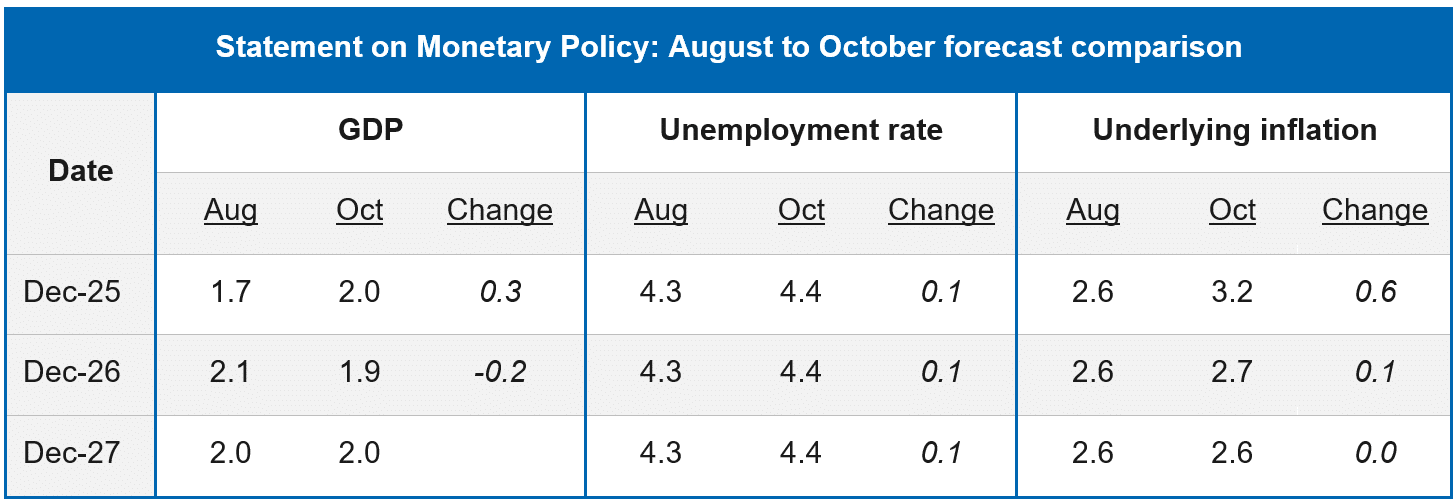
We expect only one more rate cut in this cycle, no earlier than Q2 2026. The RBA’s updated forecasts and heightened near-term inflationary pressures, combined with the challenge of returning inflation to the target midpoint, suggest rates will remain on hold for an extended period. Q3 2026 is our preferred timing for a rate cut, though we hold both this timing and the expectation of one more cut with low conviction given the heightened uncertainty.
Some economists project no further cuts in this cycle, a position we view as a distinct possibility. However, we are maintaining a forecast of one 25 basis point cut for now for three reasons: our outlook for softer global growth, expected cooling in labour market conditions and our assessment that policy remains slightly restrictive at 3.60%.
The trajectory of employment, as well as inflation, over the next six to nine months will be critical in determining whether this forecast proves accurate or whether rates remain on hold through the entire cycle. The unemployment rate was revised slightly higher across the forecast horizon, from 4.3% to 4.4%. Governor Bullock also noted that business liaison revealed businesses are still finding it difficult to source labour. A deterioration in the labour market beyond the RBA’s forecasts could increase the likelihood of another rate cut.
In other views, swap markets have a probability of 70% attached to one more rate cut with a timing of August 2026. And according to the Australian National University’s RBA Shadow Board, the probability distribution suggests rates on hold are favoured over the next six months and then a rate cut slightly favoured over 12 months.